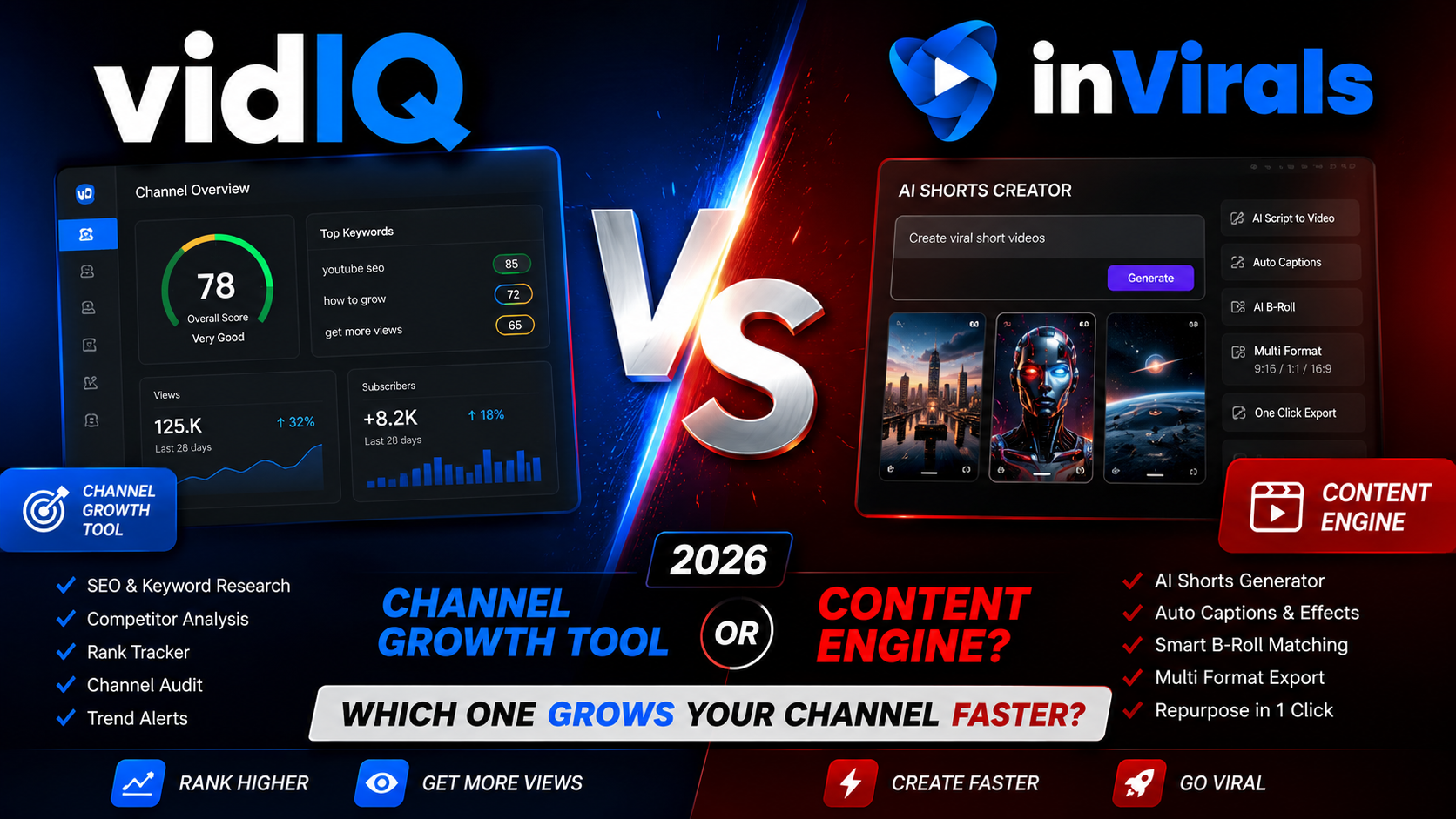
vidIQ vs inVirals 2026: Channel Growth Tool or Content Engine?
vidIQ and inVirals get compared a lot, but they solve different problems. vidIQ is a channel optimization and keyword research tool. It tells you what to make and how to optimize titles, tags, and thumbnails for the YouTube algorithm. inVirals is a content creation engine. It actually produces the videos, faceless shorts generated from a topic, and posts them automatically. Understanding this difference is the key to deciding which you need in 2026, or whether the smartest move is using both together.
The confusion is understandable, because both tools promise to help you grow, and growth is the goal either way. But "help you grow" splits into two very different jobs: figuring out what content to make, and actually making it. One tool answers the first question and the other does the second, which is why framing them as rivals leads people to buy the wrong one for their situation. The rest of this article keeps that distinction front and center so you can match the tool to the bottleneck you actually have.
This comparison breaks down what each tool does, who it is for, and how they can complement each other.
Two halves of one workflow
The clearest way to think about vidIQ and inVirals is as the two halves of how content actually gets made and grows. Every successful channel runs on a loop: decide what to make, make it, publish it, measure what happened, and use that data to decide what to make next. vidIQ lives at the start and end of that loop, the deciding and the measuring. inVirals lives in the middle, the making and the publishing. Calling them competitors is like calling a recipe a competitor to the oven; they operate at different stages.
This distinction matters because creators often buy the wrong tool for their actual bottleneck. If you have ten great topic ideas but no time to produce videos, more keyword research will not help, your problem is production. If you produce constantly but nothing lands, more production capacity will not help, your problem is targeting. Diagnosing which half is your real constraint is the single most useful thing you can do before spending money on either tool.
What vidIQ does
vidIQ is primarily an analytics and research browser extension and dashboard. It overlays data directly onto YouTube as you browse, so you can size up a topic or a competitor without leaving the platform. Its strengths are:
- Keyword research — find what people search for on YouTube and how competitive each term is.
- Competitor analysis — see what is working on other channels.
- Title, tag, and description optimization — suggestions to improve discoverability.
- Performance tracking — monitor your channel's stats and trends.
What vidIQ does not do is create the actual videos. It tells you what to make; you still have to produce it.
vidIQ's real strength: removing guesswork from topic selection
The deepest value of vidIQ is that it replaces intuition with data at the riskiest stage of content: deciding what to make. Without research, you are guessing which topics your audience wants, and a guess that misses means a video that flops, hours of work wasted on something nobody searched for. vidIQ shows you the search volume behind a topic, how hard it will be to rank, and what is already working for competitors. That turns "I think this might do well" into "this term has demand and weak competition." For creators who produce slowly and can only afford a few videos a week, that confidence is worth a lot, because every video has to count.
What inVirals does
inVirals is the production side of the equation. Its strengths are:
- AI video generation — turn a topic into a finished faceless short with script, visuals, voice, captions, and music.
- Daily automation — generate and post to TikTok, YouTube, and Instagram on a schedule.
- Multiple formats — faceless videos, clipping long content, UGC ads, and image-to-video.
- Built-in editing — refine captions, timing, and effects without leaving the app.
inVirals does not do keyword research the way vidIQ does. It creates and publishes; you bring the topic or use its trending suggestions.
inVirals's real strength: removing the production bottleneck
The defining value of inVirals is that it collapses the entire production chain, scripting, visuals, voice, captions, music, and publishing, into a single step. For most aspiring creators, production is the true bottleneck. They have ideas; what they lack is the time, equipment, editing skill, or on-camera confidence to turn those ideas into finished videos day after day. By generating a complete faceless short from a single topic in minutes, inVirals makes daily output realistic for one person. That changes the math of growth: instead of agonizing over a handful of videos a month, you can publish daily across three platforms and let real audience data, not guesswork, reveal what works. The AI shorts generator and the text-to-video workflow are what make that volume achievable without a team.
vidIQ vs inVirals: side by side
| Capability | vidIQ | inVirals |
|---|---|---|
| Keyword research | Yes | Basic suggestions |
| Competitor analysis | Yes | No |
| Title/tag optimization | Yes | Partial (auto-metadata) |
| Video creation | No | Yes |
| Faceless video generation | No | Yes |
| Auto-posting | No | Yes |
| AI voices and visuals | No | Yes |
| Best for | Research and optimization | Creating and publishing |
Which one do you actually need?
Choose vidIQ if
You already create videos (faceless or not) and your bottleneck is knowing what topics to target and how to optimize for the algorithm. vidIQ is a research and optimization layer, not a production tool. It is the right first purchase for an established creator whose output is already steady but whose videos are not finding the audiences they deserve. In that case, better targeting and metadata can unlock reach you are already producing the content to earn.
Choose inVirals if
Your bottleneck is production, actually making and posting videos consistently. If you do not want to film, edit, or manually upload, inVirals removes that work entirely by generating and auto-posting faceless content. This is the right first purchase for the far larger group of people whose channels never get off the ground because producing videos by hand is too slow to sustain. Solve production first and you finally have a steady stream of published videos to learn from and optimize later.
Use both if you want the complete system
This is the power move. Use vidIQ to research high-opportunity keywords and topics, then feed those topics into inVirals to generate and auto-post the videos. Research plus production equals a complete growth machine. vidIQ tells you what to make; inVirals makes it. The two together close the full content loop, you decide what to make with data, produce it effortlessly, publish everywhere automatically, then return to the data to decide what to make next.
Bottom line: vidIQ and inVirals are not really competitors. They are two halves of a faceless channel workflow, research and production.
Where each tool fits in the content loop
To make the division of labor concrete, here is how the same five-stage loop maps onto each tool. Notice that there is almost no overlap, which is exactly why they pair so well.
| Stage | vidIQ | inVirals |
|---|---|---|
| Decide what to make | Keyword and competitor research | Trending topic suggestions |
| Make the video | Not supported | Full generation: script, visuals, voice, captions |
| Publish it | Not supported | Auto-post to TikTok, YouTube, Instagram |
| Measure results | Deep analytics and tracking | Basic performance signals |
| Decide what to make next | Strong, data-driven | Generate more of what worked |
The gaps in each column are the point. vidIQ has nothing in the "make" and "publish" rows; inVirals is light in the "measure" row. Used alone, each leaves part of the loop unautomated. Used together, the loop closes, and a closed loop is what compounds into growth over months rather than producing a few scattered hits.
The case for production-first thinking
If you are forced to pick one tool to start with, the honest answer for most beginners is production. Here is the reasoning. Research tells you what might work, but research is only a prediction. The only way to know what actually works for your specific audience is to publish and watch the data. A creator with 200 published videos and no formal research will almost always out-learn a creator with perfect research and 10 published videos, because the first creator has 20 times more real-world feedback to learn from.
Production is also the harder bottleneck to break by willpower alone. Anyone can spend an afternoon researching keywords. Very few people can film, edit, and upload a quality video every single day for months. That is the wall most channels hit, and it is exactly the wall an AI faceless video generator removes. Once production is effortless, research becomes the high-leverage add-on, because now you can actually act on every insight at volume.
How research makes generated content better
None of this means research is optional once you scale. The opposite is true: research is what stops you from generating 200 videos nobody searches for. vidIQ-style keyword and competitor analysis tells you which topics have demand and which are saturated, so the videos you generate are aimed at real audiences. Here is how to feed research directly into generation:
- Mine low-competition keywords. Find search terms with high interest and weak existing content, then generate shorts targeting exactly those terms.
- Study breakout competitors. When a rival's video pops, note the angle and format, then produce your own original take with the AI script generator.
- Validate before scaling. Generate two or three videos on a researched topic, watch the data, and only batch-produce the angle once it proves out.
- Optimize titles and tags. Use research insights to refine the metadata on your auto-posted videos for better discoverability.
A combined workflow example
Here is what the research-to-publish loop looks like in practice over a single week. It takes only a few minutes of active work per day once it is set up, because the heavy lifting is split between research automation on one side and production automation on the other.
- Open vidIQ and find 10 low-competition, high-search topics in your niche.
- Enter each topic into inVirals to generate a faceless short.
- Let inVirals auto-post to YouTube, TikTok, and Instagram.
- Track performance in vidIQ and double down on the topics that rank.
- Generate more variations of winning topics in inVirals.
This loop combines smart targeting with effortless production, exactly what fast-growing faceless channels do. The key is that neither half waits on the other: research runs in the background while production runs on automation, so the only thing demanding your attention is the weekly decision about what to double down on.
Common mistakes when choosing between them
- Buying research before you can produce. A pile of validated topics is worthless if you never make the videos. If production is your wall, fix that first.
- Producing with zero targeting. Generating 100 videos on topics nobody searches for wastes effort. A little research aims your volume at real demand.
- Expecting vidIQ to make videos. It is a research and optimization layer, not a production tool. It will never generate a single clip.
- Expecting inVirals to replace deep keyword research. It offers trending suggestions and auto-metadata, but for granular competitor and keyword analysis, a dedicated research tool goes deeper.
- Treating them as either/or forever. Many creators start with production to build momentum, then add research once they have data worth optimizing.
Which tool to start with, by creator type
| Your situation | Start with | Add later |
|---|---|---|
| No content yet, no time to film | inVirals | vidIQ once you have data |
| Posting already but stuck on what to make | vidIQ | inVirals to scale output |
| Existing long-form channel | vidIQ for SEO | inVirals to clip and repurpose |
| Want full hands-off faceless growth | inVirals | vidIQ for targeting refinement |
Cost and value: do you need both?
Whether running both is worth it depends on your stage. Early on, a single subscription that gets you publishing daily delivers more value than a research tool you cannot yet act on, so production-first usually wins on cost-efficiency. As your channel matures and each video represents real reach, the marginal value of better targeting rises, and that is when adding a research layer pays for itself. Look at the inVirals pricing in the context of how many videos you plan to publish; for most creators, the production tool is the one that turns spend into actual published content, while research is the optimization you layer on once volume is no longer the problem.
The bottom line
vidIQ optimizes; inVirals creates. If you only buy one and your problem is making content consistently, inVirals is the tool that removes the heavy lifting. If your problem is knowing what to make, vidIQ helps. Together, they form a powerful research-to-publish system: vidIQ points you at the topics with real demand, and inVirals turns those topics into finished, auto-posted videos without you filming or editing a thing. Most creators find that production is the wall they actually need to break first, then layer research on top once they have a steady stream of published content to optimize. Start creating with inVirals and turn your research into published videos automatically.
Frequently asked questions
Is inVirals a vidIQ competitor?
Not directly. vidIQ is a research and optimization tool, while inVirals is a content creation and automation engine. They serve different stages of the workflow.
Can I use vidIQ and inVirals together?
Yes, and many creators do. Use vidIQ to find topics and inVirals to generate and post the videos for those topics.
Does inVirals help with YouTube SEO?
inVirals auto-generates titles, descriptions, and hashtags when posting, which helps discoverability. For deep keyword research, a tool like vidIQ complements it well.
Which should a beginner start with?
If you have no content yet, start with inVirals to build a posting habit and a content library, then add vidIQ for optimization as you grow.
Can inVirals generate videos from the topics vidIQ finds?
Yes, and that is the ideal pairing. Take a high-opportunity keyword from vidIQ, enter it into inVirals, and the platform produces a complete faceless short, script, visuals, voice, and captions, aimed at that exact search demand.
Does inVirals do any keyword or trend research at all?
It offers trending topic suggestions and auto-generates titles, descriptions, and hashtags, which covers the basics. For granular keyword volume and competitor breakdowns, a dedicated research tool like vidIQ goes deeper.
Is one tool enough, or do serious creators use both?
Many serious creators use both because they cover different stages of the loop. That said, plenty of fast-growing faceless channels run on production alone early on and add research only once they have enough data to optimize.
Can I use inVirals for TikTok and Reels, not just YouTube?
Yes. While vidIQ is YouTube-focused, inVirals generates and auto-posts to TikTok, YouTube, and Instagram, so the same content base grows you across all three short-form feeds.