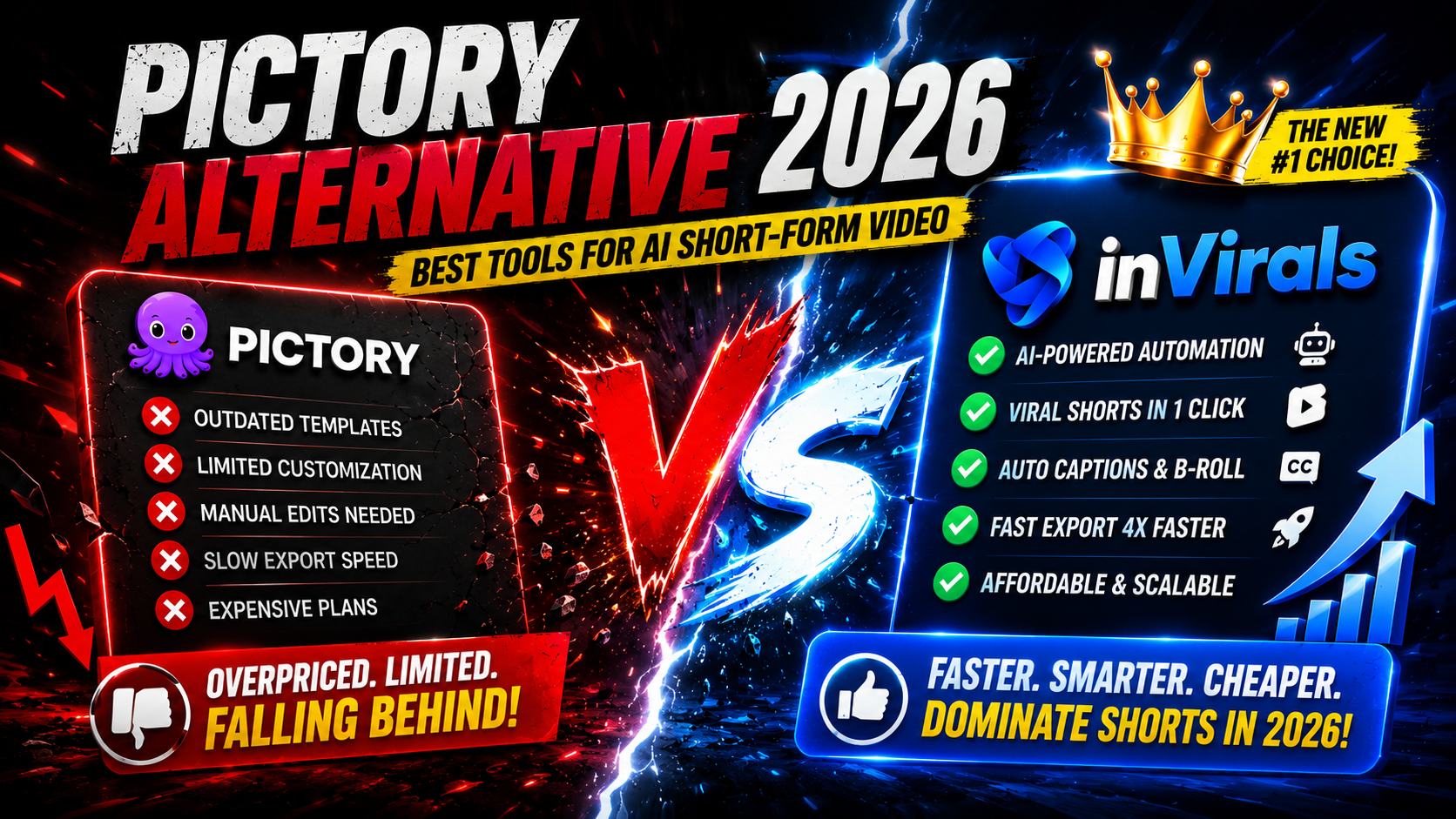
Pictory Alternative 2026: Best Tools for AI Short-Form Video
Pictory built its reputation on turning text and long-form content into videos using stock footage and AI voiceovers. It is popular with marketers and bloggers who want to convert articles into video summaries. But like many first-generation AI video tools, Pictory shows its age when you need modern, native-feeling short-form content for TikTok, YouTube Shorts, and Instagram Reels. If you are looking for a Pictory alternative in 2026, you are probably after better visuals, real automation, or a workflow built specifically for faceless creators.
This guide breaks down why creators move on from Pictory, what to prioritize, and how the leading alternatives compare so you can choose with confidence. We will go deep on visual quality, automation, voices, pricing logic, and the practical day-to-day workflow differences that decide whether a tool actually helps you grow or just helps you produce one-off videos.
Pictory in 2026: a quick honest assessment
Credit where it is due. Pictory was one of the tools that proved you could go from written content to a watchable video without touching a traditional editor. Its script-to-video and article-to-video features genuinely save time for content teams that publish a lot of written material. The auto-captioning is reliable, the stock library is large, and the learning curve is gentle. For a marketing department repurposing a blog into a LinkedIn clip, it remains a sensible pick.
The problem is that the short-form world moved. Audiences in 2026 scroll past anything that looks templated, and the algorithms on TikTok, Reels, and Shorts increasingly reward content that feels native and original. A montage of licensed stock clips with a synthetic voiceover reads as "ad" or "filler" within the first second, and the first second is the entire game in short-form. That mismatch, more than any single missing feature, is why creators start hunting for an alternative.
Why creators look for a Pictory alternative
1. Stock-footage dependence
Pictory mostly assembles videos from stock clips. That was fine a few years ago, but in 2026 audiences are tired of seeing the same generic footage across thousands of videos. Original AI-generated visuals and consistent characters stand out and hold attention far better. When ten different creators in your niche all pull from the same stock library, their videos blur together, and the algorithm has no reason to favor yours. Original visuals break that pattern and give viewers a reason to stop scrolling.
2. Built for repurposing, not native short-form
Pictory shines at turning a blog post or webinar into a video. It is less suited to generating original, trend-aware faceless shorts from a simple topic. Creators who want viral-style content for short-form platforms often find the output feels more like a slideshow than a native TikTok. The pacing, the hook structure, and the visual rhythm of a winning short are different from a summary video, and a tool optimized for the latter rarely nails the former.
3. No real daily automation
Pictory helps you create videos faster, but it does not run an autonomous daily series that generates and posts to your channels automatically. Faceless growth depends on consistent daily output, and manual creation becomes a bottleneck. If you have to log in, paste a script, pick clips, render, download, and upload every single day, you have bought yourself a faster manual process, not freedom. The creators who win in short-form are the ones who post consistently for months, and consistency at that scale demands genuine automation.
4. Limited format range
If you also want to clip long videos, create UGC ads, or generate image-to-video content, Pictory does not cover those needs in one place. You end up stitching together a stack of subscriptions, each with its own login, billing cycle, and export quirks. That fragmentation costs money and, more importantly, costs attention you would rather spend on strategy and ideas.
What matters in a Pictory alternative
- Original AI visuals instead of recycled stock footage.
- Native short-form output optimized for TikTok, Shorts, and Reels.
- True auto-posting with a daily series.
- Realistic voices in many languages.
- Multiple formats in one tool: faceless generation, clipping, UGC, image-to-video.
- Beginner-friendly, no-code workflow.
Run any candidate tool through those six filters before you commit. A tool can be excellent at one of them and still leave you stuck. The goal in 2026 is not a faster way to make a single video; it is a system that turns ideas into published, native-feeling content without you babysitting every step. If you are starting from scratch, an AI faceless video generator built around these principles will save you months of trial and error.
inVirals vs Pictory: comparison
| Feature | inVirals | Pictory |
|---|---|---|
| Original AI visuals / characters | Yes | Mostly stock |
| Native short-form generation | Yes | Limited |
| Faceless daily series + auto-post | Yes | No |
| AI script generator | Yes | Basic |
| Article/text to video | Yes | Yes |
| Clip long videos into shorts | Yes | Limited |
| UGC ads and image-to-video | Yes | No |
| Realistic voices, languages | 20+ languages | Yes |
Why inVirals is the stronger Pictory alternative
Modern, original visuals
The biggest upgrade over Pictory is visual quality. inVirals generates original AI images and can maintain consistent characters across a video, in trending styles like cinematic, anime, documentary, and comic. This is what makes a short feel native to the platform rather than a recycled stock montage. Because the visuals are generated to match your script rather than pulled from a shared library, two creators in the same niche can produce completely distinct-looking videos from the same topic.
Built for faceless short-form, not slideshows
inVirals is engineered for the exact content that grows on short-form platforms: hook-first scripts, vertical format, captions, music, and pacing tuned for retention. You are not adapting a marketing tool to do something it was not designed for. The AI shorts generator handles the structural decisions that usually take experience to get right, so your first videos already follow the patterns that hold attention past the three-second drop-off.
Automation that actually runs your channel
Connect your TikTok, YouTube, and Instagram accounts, set up a daily series, and inVirals generates and posts new content automatically. Pictory can speed up a single video, but it cannot run your channel for you. This is the difference between a tool and a system. With a daily series active, your channel keeps publishing whether or not you log in, which is exactly what consistent short-form growth requires.
One tool for every format
inVirals covers faceless generation, the AI clip generator, UGC ads, and image-to-video. That is a complete content engine for organic and paid, replacing several separate subscriptions. When your strategy expands, the tooling expands with it instead of forcing you to learn and pay for yet another platform.
Scripts and hooks that do the heavy lifting
Most videos fail at the script stage, not the visual stage. inVirals includes an AI video script generator and an AI video hook generator that produce structured, retention-aware copy from a single topic. Instead of staring at a blank page, you start with a hook, a body, and a payoff, then refine. That alone closes a gap Pictory never really addressed beyond basic text summarization.
A real workflow comparison
To make the difference concrete, here is how the same task plays out in each tool. Say you want to publish a daily faceless history channel on YouTube Shorts and TikTok.
The Pictory workflow
- Write or paste a script for each video.
- Let Pictory match stock clips to the script segments.
- Swap out the clips that do not fit, which is most of them in a niche subject.
- Generate a voiceover and adjust timing.
- Render and download the file.
- Manually upload to each platform, writing titles and hashtags yourself.
- Repeat all of the above tomorrow.
The inVirals workflow
- Enter your niche and choose a visual style and voice once.
- Activate a daily series.
- Review or tweak the generated videos if you want to; otherwise let them publish automatically.
The first workflow is a part-time job. The second is a setup you do once and monitor occasionally. Over a 90-day push, that difference compounds into dozens of hours saved and, crucially, into the consistency that the algorithms actually reward.
Common mistakes when switching from Pictory
- Treating the script like a blog post. Short-form scripts are spoken, punchy, and front-loaded. Do not paste 800 words of article prose and expect a native feel.
- Ignoring the hook. The first line decides everything. Spend more time on the opening three seconds than on the rest of the video combined.
- Over-editing. Once you have a tool generating native-quality output, resist the urge to micromanage every frame. Volume and consistency beat per-video perfection in short-form.
- Posting to one platform only. The same faceless short can run on TikTok, Shorts, and Reels. Use a tool that publishes to all three rather than re-uploading manually.
- Switching niches too fast. Give a niche at least a few weeks of daily posting before judging it. Automation makes this easy; impatience undoes it.
Pricing logic: why all-in-one usually wins
People often compare tools on sticker price alone, but the real number is total cost to achieve your goal. If a single tool handles generation, captions, clipping, UGC, and auto-posting, you are paying one subscription. If you build the same capability from Pictory plus a clipping tool plus a scheduler plus a separate UGC tool, you are paying four times and managing four workflows. Before deciding, look at the inVirals pricing in the context of everything it replaces, not just the line item. For most growing creators, consolidation is cheaper and far less fragmented.
Visual quality: the detail that decides everything
It is worth dwelling on visuals, because in short-form they are not a nice-to-have, they are the difference between a scroll-past and a watch. The first frame of your video competes against an infinite feed, and viewers make a stay-or-leave decision in milliseconds, largely on what they see. Stock-based videos lose that battle in a specific way: because the same clips circulate across thousands of videos, a viewer's brain registers the footage as familiar and therefore skippable. Familiarity is the enemy of the scroll-stop.
Original AI visuals flip that dynamic. When the imagery is generated specifically for your script, in a consistent style the viewer has not seen a hundred times, it reads as new, and novelty is what earns the first two seconds of attention. This is also why consistent characters matter: a recurring visual identity turns a string of one-off videos into a recognizable brand that viewers start to follow. A stock library cannot give you that, by definition, because everyone draws from the same well. If your niche leans on illustrating spoken ideas, the text-to-video approach turns each script line into a matching original visual without you sourcing a single clip.
Migrating your Pictory workflow without losing momentum
Switching tools sounds disruptive, but the parts of your workflow worth keeping transfer cleanly. Your niche, your proven topics, and your understanding of your audience all carry over, those are strategy, not software. What changes is the production layer underneath. Keep your best-performing topic ideas, then regenerate them as native short-form using the script generator rather than pasting in article prose. The result is the same idea expressed in a format built to perform, instead of a summary video adapted from a tool that was never designed for the short-form feed.
When Pictory is still a reasonable choice
If your main need is converting blog articles or webinars into simple summary videos for a website or LinkedIn, and you are comfortable with stock footage, Pictory does that job. The alternative matters most when you want original visuals, native short-form content, and automated faceless growth. There is no shame in using the right tool for a narrow job; the point is to match the tool to the outcome you actually want. If that outcome is a growing faceless channel, you have outgrown what Pictory was built to do.
Making the switch to inVirals
- Create an account at invirals.com.
- Pick your niche, visual style, and voice.
- Generate your first faceless short from a topic in under two minutes.
- Connect your channels and activate a daily series for automated posting.
- Use the clip generator and UGC tools as your content needs expand.
If you primarily care about TikTok, start with the AI TikTok video generator and let the platform tune the format and pacing for that feed specifically. You can always branch into Shorts and Reels from the same content base later.
The bottom line
Pictory was a solid first-generation tool, but faceless creators in 2026 need original visuals, native short-form output, and real automation. inVirals delivers all three, plus clipping, UGC ads, and image-to-video in one platform, making it the strongest Pictory alternative this year. Try inVirals and upgrade your short-form game today.
Frequently asked questions
Is inVirals better than Pictory for short-form video?
For native TikTok, Shorts, and Reels content with original visuals and automation, yes. Pictory is better suited to converting articles into simple stock-based summary videos. If your goal is consistent faceless growth rather than occasional repurposing, inVirals is the stronger fit.
Can inVirals turn text into video like Pictory?
Yes. You can generate a complete video from a topic or script, with original AI visuals rather than only stock footage. The text-to-video workflow takes a written idea and produces a finished, captioned short with voiceover and music.
Does inVirals support multiple languages?
Yes. It offers realistic AI voices in 20+ languages, helping you reach global audiences. You can run the same niche in several languages to expand reach without re-recording anything yourself.
Is inVirals beginner-friendly?
Yes. The workflow is fully no-code. Enter a topic, choose a style and voice, and the platform produces a finished short automatically. There is no timeline editor to learn unless you want to fine-tune.
How is the visual quality different from Pictory's stock footage?
Pictory assembles licensed stock clips, so videos in the same niche often look alike. inVirals generates original AI visuals matched to your script and can maintain consistent characters across a video, which makes each short feel distinct and native to the platform.
Can I migrate my existing content strategy without starting over?
Yes. Keep your proven topics and niche, then rebuild the production side in inVirals. Use the script and hook generators to adapt your best-performing ideas into native short-form, and let a daily series handle ongoing output while you focus on strategy. Your audience understanding and topic research are strategy assets that transfer regardless of which tool produces the videos.
Does inVirals work for paid ads as well as organic content?
Yes. Alongside organic faceless shorts, it includes UGC ads and image-to-video, so you can produce native-feeling ad creative in the same platform you use for organic growth, something Pictory does not offer.
The bottom line on choosing a Pictory alternative
Pictory is a capable repurposing tool, but it was built for a different job than generating original faceless videos from scratch. If your channel depends on a steady stream of fresh short-form content rather than recutting existing footage, you will get more leverage from a generator that owns the whole pipeline. That means scripting, AI visuals, realistic voiceover, captions, music, and automated posting in one place, instead of paying for several tools that each solve a fragment of the workflow. Before you commit to an annual plan anywhere, run a one-week test: produce ten videos in your real niche, measure the time per finished clip, and confirm the auto-posting actually reaches your connected accounts end to end. The tool that lets you ship consistently without babysitting every export is the one that will still be in your stack a year from now. If that sounds like what you need, start creating with inVirals and compare the difference against your current workflow directly, or review the pricing tiers against your real monthly posting volume first.