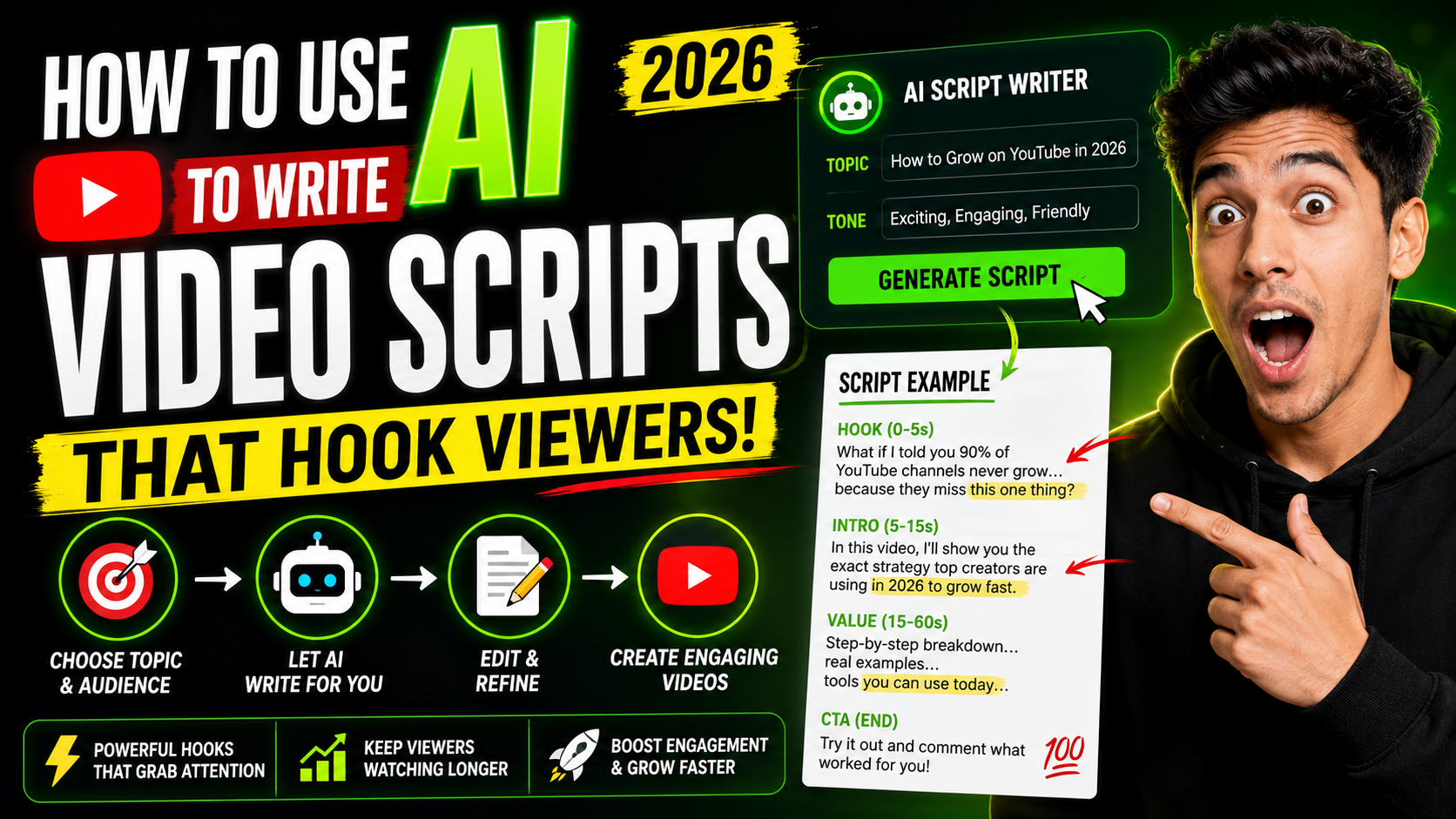
How to Use AI to Write Video Scripts That Hook Viewers (2026)
The script is the foundation of every successful video. A great visual style and a realistic voice cannot save a weak script, but a strong script can carry even simple visuals to viral reach. The good news is that AI has become remarkably good at writing video scripts, especially the short, punchy, retention-focused scripts that short-form platforms reward. The key is knowing how to direct the AI. This guide shows you how to use AI to write video scripts that actually hook viewers and keep them watching.
Why scripts matter more than anything else
On TikTok, YouTube Shorts, and Reels, the algorithm rewards watch time and completion. Both are driven primarily by the script:
- The hook (first second) decides if viewers stay or scroll.
- The structure (middle) decides if they keep watching.
- The ending decides if they loop, share, or save.
Get the script right and everything else amplifies it. Get it wrong and nothing else matters.
The anatomy of a high-retention script
Every strong short-form script follows a simple structure:
- Hook (0-1s): A line that creates curiosity, makes a bold claim, or interrupts the pattern.
- Setup (1-5s): Quickly establish what the video is about and promise value.
- Payload (5-40s): Deliver the story, facts, or value efficiently, no filler.
- Loop/CTA (final seconds): End in a way that encourages rewatching, sharing, or following.
Hook formulas that work
The hook is everything. Here are proven patterns you can have AI generate:
| Hook Type | Example |
|---|---|
| Curiosity gap | "The real reason [thing] happens will surprise you..." |
| Bold claim | "Everything you know about [topic] is wrong." |
| Pattern interrupt | "Stop scrolling. This changes [outcome]." |
| Negative/warning | "Never do [common action]. Here's why." |
| Listicle promise | "3 [things] that will [benefit] in 30 days." |
| Story open | "In 1997, something happened that nobody can explain..." |
Step 1: Use a purpose-built AI script generator
General AI chatbots can write scripts, but tools built specifically for video scripts produce better, more retention-focused output. The inVirals AI script generator is trained for short-form formats, it writes hook-first scripts in formats like UGC, did-you-know, ranking, and story, optimized for the platforms you are targeting.
Step 2: Give clear direction
The quality of an AI script depends on the input. Specify:
- Topic: Be specific. "Psychology of confidence" beats "self-help."
- Format: Story, listicle, fact-based, POV, tutorial.
- Tone: Authoritative, energetic, mysterious, conversational.
- Length: Target duration (e.g., 30 seconds).
- Audience: Who it is for, so language matches.
Step 3: Refine the output
AI gives you a strong first draft, but the best creators refine it:
- Sharpen the hook. If the first line is not gripping, regenerate or rewrite it.
- Cut filler. Remove any sentence that does not add value or move the story.
- Read it aloud. If it sounds awkward spoken, adjust it, scripts are heard, not read.
- Tighten the ending. Make sure it loops or prompts an action.
Step 4: Match script to delivery
A script is only as good as its delivery. In inVirals, once the script is ready, you pair it with a matching AI voice and visual style. A mysterious script needs a deep, slow voice and dark visuals; an energetic motivation script needs an upbeat voice and dynamic imagery. The script and delivery must reinforce each other.
Step 5: Build a script system, not one-offs
For consistent content, create a repeatable system:
- Keep a running list of topics in your niche.
- Generate scripts in batches using your best-performing format.
- Track which hooks and formats get the highest retention.
- Feed those winners back into the AI as templates for more.
Common scripting mistakes to avoid
- Slow intros. Never start with "Hey guys, welcome back." Hook immediately.
- Too much information. One idea per short. Depth over breadth.
- Weak endings. Do not trail off. End with impact or a loop.
- Generic AI output. Always refine; never post the raw first draft without review.
Proven script frameworks AI can fill in for you
Hooks open the video, but frameworks carry it. A framework is a reusable skeleton that organizes your message so it lands. When you tell the AI which framework to use, the output stops feeling random and starts feeling intentional. These four cover the vast majority of short-form content.
PAS — Problem, Agitate, Solution
Name a problem the viewer has, twist the knife by showing why it is worse than they think, then deliver the solution. It works for advice, finance, health, and productivity content. Example structure: "You save money every month but still feel broke (problem). That is because inflation is quietly eating your savings while it sits in a checking account (agitate). Here is where to put it instead (solution)."
AIDA — Attention, Interest, Desire, Action
Borrowed from advertising, AIDA suits any video meant to drive a click or follow. Grab attention with the hook, build interest with a surprising detail, create desire by showing the payoff, then prompt action. It is the natural backbone for affiliate-driven and product-adjacent content.
The story arc
Setup, tension, climax, resolution. This is the strongest framework for true crime, history, mystery, and narrative niches because human brains are wired to finish stories they have started. The unresolved tension is what stops people from scrolling.
The list payload
Hook, then rapid-fire numbered points, then a button-up line. Lists are the easiest format to batch because the structure never changes — only the items do. "5 habits", "3 mistakes", "7 facts" all run on the same rails.
| Framework | Best for | Why it works |
|---|---|---|
| PAS | Advice, finance, health | Creates urgency around a real pain point |
| AIDA | Affiliate, product, CTA videos | Guides the viewer toward one action |
| Story arc | True crime, history, mystery | Open loops keep viewers to the end |
| List payload | Facts, tips, rankings | Easy to batch and highly skimmable |
Writing prompts that get great scripts
The difference between a mediocre AI script and a great one is almost always the prompt. Vague inputs produce vague, generic output. Specific inputs produce sharp, usable scripts. The best prompts stack five layers of direction together rather than naming a topic alone.
Compare these two prompts. Weak: "Write a script about saving money." Strong: "Write a 35-second TikTok script for a faceless finance channel aimed at people in their twenties. Use the PAS framework. Open with a contrarian hook about why budgeting apps do not work. Tone: blunt and confident, like a friend who knows money. End on a loop that makes them rewatch." The second prompt gives the AI a format, a length, an audience, a framework, a tone, and an ending instruction. The result is night-and-day better.
A reusable prompt template
- Format and length: "Write a [duration] script for [platform]."
- Audience: "Aimed at [specific viewer]."
- Framework: "Use the [PAS / AIDA / story / list] structure."
- Hook direction: "Open with a [curiosity / bold claim / warning] hook about [angle]."
- Tone: "Voice should be [tone descriptor]."
- Ending: "Close with a [loop / CTA / cliffhanger]."
Save this template and swap the variables for each video. A purpose-built AI video script generator bakes much of this in, so you choose a format and topic and it applies the rest automatically. If you only need to nail the opening line, an AI video hook generator can spin out a dozen hook variations to test against each other.
Tailoring scripts to each platform
A script that crushes on TikTok can underperform on YouTube Shorts if you do not adjust the pacing. The platforms reward slightly different rhythms, and AI lets you regenerate the same idea for each one in seconds.
| Platform | Ideal length | Script emphasis |
|---|---|---|
| TikTok | 15-34 seconds | Fastest hook, trend-aware language, punchy lines |
| YouTube Shorts | 30-50 seconds | Clear value promise, slightly more depth, keyword in first line |
| Instagram Reels | 20-40 seconds | Aesthetic-friendly, question that invites comments |
| Long-form YouTube | 8+ minutes | Layered structure, multiple loops, mid-roll-friendly pacing |
For a multi-platform faceless workflow, write the core idea once, then ask the AI to produce three length variants. Pair the finished scripts with an AI faceless video generator so the same idea ships everywhere without re-recording anything. If you are scripting specifically for TikTok's faster cadence, an AI TikTok video generator keeps the rhythm native to that feed.
A worked example: topic to finished script
Say your niche is space facts and your topic is "why a day on Venus is longer than its year." Here is how the AI moves from idea to script. First, it writes a curiosity-gap hook: "Venus is so strange that a single day there lasts longer than its entire year." Next comes a one-line setup that promises the payoff: "Here is why that actually happens." Then the payload delivers the explanation in two or three tight sentences — Venus rotates incredibly slowly while orbiting the sun relatively fast, so it completes an orbit before it finishes a rotation. Finally, the loop closes it: "Which means if you lived there, you would have a birthday before lunchtime." That last line nudges a rewatch and a share.
Notice how every line earns its place. No throat-clearing intro, no "in today's video," no filler. The whole thing runs about 55 spoken words, lands in roughly 30 seconds, and respects the viewer's attention. That economy is the hallmark of a script written for retention rather than for reading.
Pacing, word count, and rhythm
Spoken pace on short-form runs roughly 2.2 to 2.8 words per second. That means a 30-second video needs about 70 to 85 words, and a 45-second video needs about 100 to 120. Writing past that forces the voiceover to rush or the video to overrun. When the AI hands you a draft that is too long, do not trim evenly — cut whole sentences that do not advance the point, because choppy half-sentences read worse than fewer complete ones. Vary sentence length too. A string of identical medium sentences lulls viewers; a short punchy line after two longer ones snaps attention back.
Building a repeatable batch workflow
Single scripts are fine for testing, but real channels run on batches. Once you know your winning format and framework, generate a week of scripts in one sitting. Keep a living document of your top-performing hooks and feed them back to the AI as examples so each new batch inherits what already works. Treat your script library like a compounding asset: every winner becomes a template, and every template makes the next batch faster and better. You can even paste a finished script straight into a text-to-video tool to skip the blank-canvas stage entirely.
Editing the AI draft like a pro
AI gives you a strong skeleton, but the editing pass is where good becomes great. Treat the first draft as raw clay. Start at the hook and be ruthless: if the opening line does not create a question or a jolt within the first few words, rewrite it or regenerate. Then read the whole script out loud at speaking pace. Your ear catches what your eye misses — a tongue-twister phrase, a sentence that runs out of breath, a transition that clunks. Anything you stumble over, the voiceover will stumble over too.
Next, hunt for filler. Words like "basically," "actually," "in order to," and "the thing is" almost always come out clean with no loss of meaning. Every word you remove tightens the pace and lifts retention. Finally, check the emotional through-line. Strong short-form scripts ride a single emotion — curiosity, awe, outrage, motivation — from hook to payoff. If the middle drifts into neutral explanation, inject a stakes line that reminds the viewer why this matters. These four moves — sharpen the hook, read aloud, cut filler, protect the emotion — take two minutes and routinely double a script's impact.
Repurposing long-form content into short scripts
If you already have a blog post, a podcast, or a long video, you are sitting on a goldmine of script material. Feed the long-form text to the AI and ask it to extract the three most surprising or useful points, then turn each into its own standalone short script with a fresh hook. One article can become five or six shorts this way, each pointing viewers back to the original. This is the fastest way to fill a content calendar, because the ideas are already validated — you are simply repackaging them for a new format and a new audience. Drop the resulting scripts into a text-to-video workflow and you have finished videos without ever starting from a blank page.
Manual scripting versus AI scripting: an honest comparison
Plenty of creators still write every script by hand, and it is worth understanding the trade-off rather than assuming AI is automatically better. Hand-writing gives you total control and a personal voice, but it is slow and it does not scale — a careful writer might produce three or four solid short scripts an hour. AI flips the equation: you trade a little control for enormous speed, generating a dozen drafts in the time it takes to write one by hand, then keeping your editing judgment as the quality filter.
| Factor | Manual scripting | AI scripting |
|---|---|---|
| Speed | Slow (3-4/hour) | Fast (12+/hour) |
| Consistency | Varies with energy | Steady every time |
| Voice control | Total | High, with good prompts |
| Scalability | Poor | Excellent |
| Best for | Signature, personal content | Volume, faceless channels |
For a faceless creator publishing daily, AI scripting plus a sharp editing pass is the only approach that scales without burning out. You keep the part humans do best — taste and judgment — and hand off the part machines do best, which is producing a strong first draft instantly.
The bottom line
Using AI to write video scripts in 2026 is about direction and refinement. Give the AI a specific topic, format, and tone; let it produce a hook-first draft; then sharpen the hook, cut filler, and match it to your voice and visuals. A purpose-built tool like inVirals makes this fast and produces scripts designed for retention. Start writing video scripts with AI and create content that hooks viewers from the first second.
Frequently asked questions
Can AI really write good video scripts?
Yes, especially purpose-built tools. The key is giving clear direction (topic, format, tone) and refining the output rather than posting it raw.
What makes a script go viral?
A strong hook in the first second, tight value-packed structure, and an ending that encourages looping or sharing.
How long should a short-form script be?
For a 30-second video, aim for roughly 70 to 90 spoken words. Keep it tight, every sentence should earn its place.
What is the best AI script tool for video?
inVirals includes an AI script generator built for short-form formats, and it integrates directly with video generation, voices, and visuals.
Should I write one script or several variations?
Generate at least two or three variations of the hook and ending for any video you expect to perform well. Small changes to the opening line often produce large swings in completion rate, so testing variations is far more efficient than guessing once.
How do I stop AI scripts from sounding generic?
Generic output comes from generic prompts. Specify the framework, the audience, the tone, and the ending, and give the AI an example of a hook you like. The more constraints you provide, the more distinctive and on-brand the script becomes.
Can I reuse the same script across TikTok, Shorts, and Reels?
You can reuse the core idea, but adjust the length and pacing for each platform. Regenerate a 15 to 30 second version for TikTok and a slightly longer, value-forward version for Shorts. The idea stays the same; the rhythm changes.
How many words should a one-minute script be?
Around 140 to 165 spoken words for a full minute, based on a natural narration pace of roughly 2.2 to 2.8 words per second. Write to that budget so the voiceover does not have to rush.