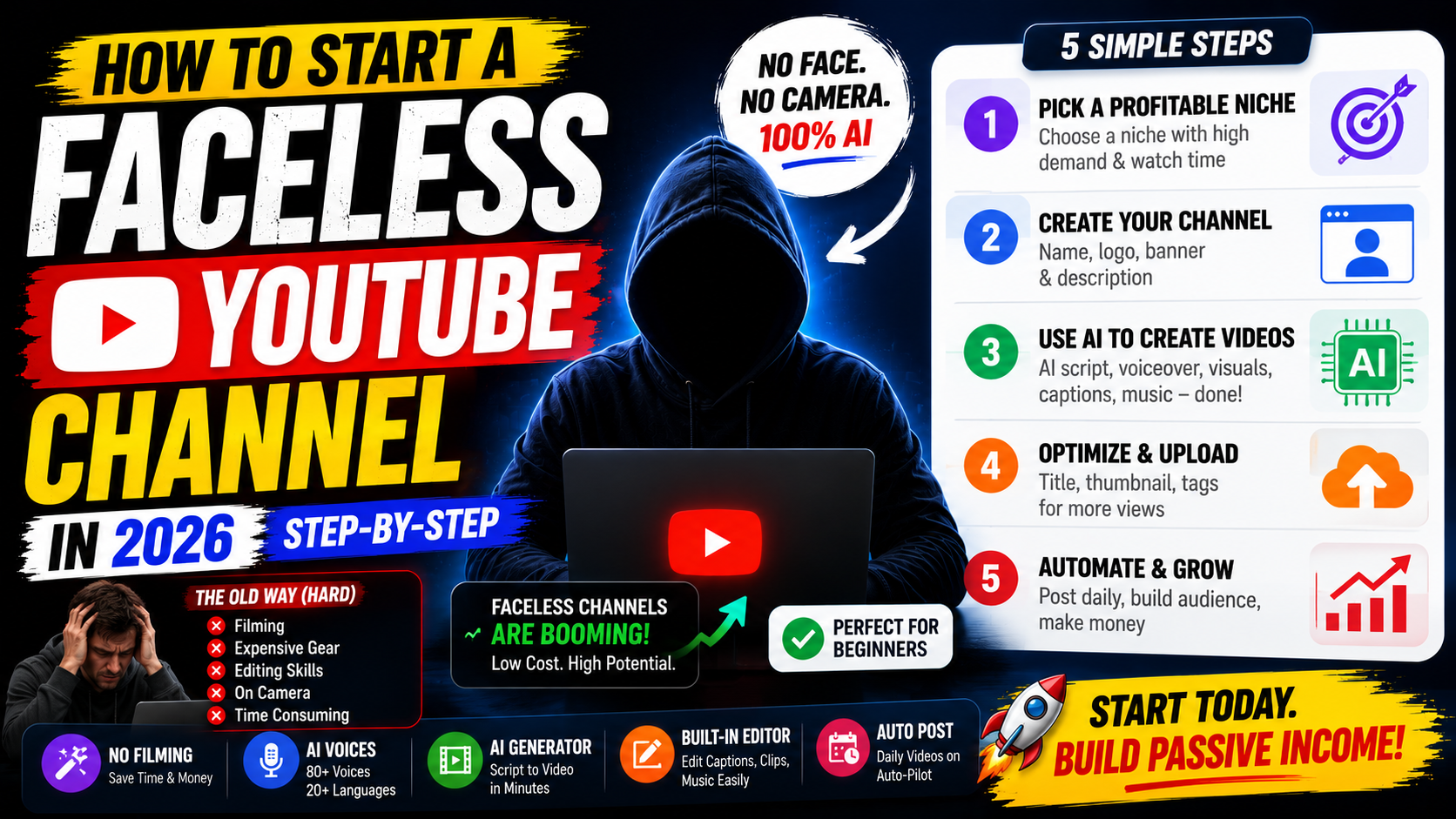
How to Start a Faceless YouTube Channel in 2026 (Step-by-Step)
A faceless YouTube channel is a channel where the creator never appears on camera. No filming, no lighting setup, no stage fright. In 2026, thousands of faceless channels earn full-time revenue through ads, sponsorships, and affiliate links using nothing but AI tools to produce content. This guide walks you through every step from zero to your first upload and beyond.
Why faceless channels are exploding in 2026
Before the steps, it is worth understanding why this model works so well right now, because the reasons also tell you how to win. Three shifts came together. First, YouTube leaned hard into Shorts to compete with TikTok, and Shorts reward consistency and watch time far more than production budget, so a well-paced clip can outperform an expensive studio video. Second, AI voices crossed the line from robotic to genuinely natural, removing the last reason a creator needed a microphone and a face. Third, generation became fast and cheap enough that one person can produce and publish daily across several channels.
The practical result is that the bottleneck is no longer talent, equipment, or budget. It is workflow and consistency. The creators who win are simply the ones who ship good videos every day without burning out, which is exactly what an AI faceless video generator is built to make possible. Keep that in mind as you read: every step below is really about removing friction so you can stay consistent.
Step 1: Pick a profitable niche
Your niche decides your ceiling. The best faceless niches have high watch time, broad appeal, and content that can be produced infinitely from new topics. Here are proven niches in 2026:
| Niche | Why it works | Example topics |
|---|---|---|
| Motivation / self-improvement | Massive audience, high RPM | Daily habits, discipline, mindset |
| True crime / mystery | Addictive retention | Unsolved cases, crime psychology |
| History / documentary | Evergreen, high watch time | Ancient civilizations, wars, inventions |
| Science / space | Visual appeal, curiosity-driven | Universe, physics, animals |
| Finance / money | High RPM, evergreen | Investing, budgeting, passive income |
| Horror / scary stories | Strong retention, viral potential | Creepypasta, urban legends |
| Top lists / rankings | Easy to batch, high CTR | Top 10 anything, comparisons |
| Gaming facts / lore | Huge audience on Shorts | Game theories, Easter eggs |
| Educational / how-to | Searchable, evergreen | Tech tips, life hacks, explainers |
Tip: Pick a niche you can produce 100+ unique topics for without running dry. If you struggle to list 20 video ideas in 10 minutes, pick something broader.
How to validate a niche before you commit
Do not marry a niche on day one. Run a quick validation pass first. Search the niche on YouTube Shorts and TikTok and look for channels under a year old that are already pulling strong view counts. Their existence proves the niche is alive and the algorithm is distributing it. Then check whether the topics are evergreen or tied to fleeting trends; evergreen topics keep earning views months after you post them, which is what compounds into real revenue. Finally, gut-check the monetization angle. A motivation channel monetizes through ads, courses, and affiliate products; a finance channel earns a high ad RPM; a horror channel grows fast through shares but may monetize better through merch and memberships. Knowing the money path before you start keeps you from building an audience you cannot turn into income.
Step 2: Create your channel
- Create a new Google account (or use an existing one).
- Go to YouTube Studio and create a new channel.
- Choose a channel name that signals your niche (e.g., "Dark History AI", "MindShift Daily").
- Design a simple logo and banner using Canva or an AI image tool.
- Write a channel description stuffed with your niche keywords.
Do not overthink branding at this stage. You can always rebrand later once you know what content performs. What matters more than a perfect logo is a name that tells both the viewer and the algorithm exactly what your channel is about, because clarity helps the system find the right audience for your videos.
Step 3: Set up your AI video tool
This is where the magic happens. An AI faceless video generator handles the parts that used to take hours: scripting, voiceover, visuals, captions, music, and export.
Here is the workflow with inVirals:
- Enter a topic — Type your video idea or let AI suggest trending topics.
- Generate a script — AI writes a hook-first script optimized for retention.
- Pick visual style — Choose from anime, cinematic, documentary, comic, and more.
- Select voice — Pick from 80+ realistic AI voices in 20+ languages.
- Generate — In under two minutes you have a finished short with captions, music, and effects.
- Auto-post — Connect your channel and let a daily series publish automatically.
This means you can go from zero content to posting every single day without filming, editing, or even being at your computer. If you want to focus on one platform first, the dedicated AI YouTube Shorts generator is tuned for exactly the vertical format and pacing YouTube rewards, while the AI video script generator handles the writing so every video opens with a retention-friendly hook.
Why the script matters more than the visuals
New creators obsess over how their videos look. Experienced ones obsess over how they are written, because the script is what holds a viewer past the three-second mark where most people scroll away. A strong faceless script front-loads the payoff, keeps sentences short and spoken, and never wastes the opening on an intro. Test different openings using an AI video hook generator and you will quickly see which angles hold attention. The visuals support the story; the script is the story. Get the writing right and even simple visuals perform; get it wrong and the most beautiful footage still gets skipped.
Step 4: Set up a daily posting schedule
Consistency beats perfection on YouTube Shorts. The algorithm rewards channels that post frequently because it gives the system more data to find your audience.
- Minimum: 3 shorts per week
- Recommended: 1 short per day (7/week)
- Aggressive: 2-3 per day (if quality stays high)
With an AI tool handling generation and posting, one short per day is low effort. Set up a daily series in inVirals, confirm the first few outputs look good, and let it run.
Step 5: Optimize for the algorithm
Even with AI doing the heavy lifting, a few decisions multiply your reach. Think of these as the levers that turn an average video into one the algorithm decides to push:
- Hook in the first second. Open with a question, a bold claim, or a visual surprise. Never start with an intro.
- Keep it under 60 seconds. Shorts under a minute get looped more, which boosts retention metrics.
- Use captions. Most viewers watch without sound initially. Captions keep them watching.
- Strong thumbnail (for long-form later). When you expand to long-form, thumbnails matter enormously.
- Title with keywords. Include what the video is about so search can find it.
Step 6: Monetize your channel
YouTube requires 1,000 subscribers and 10 million Shorts views in the last 90 days to monetize Shorts through the YouTube Partner Program. With daily posting, most channels hit this in 2-4 months.
Additional revenue streams for faceless channels:
- Affiliate links — Recommend products in your description.
- Sponsorships — Brands pay for mentions once you have an audience.
- Digital products — Sell templates, guides, or courses related to your niche.
- Cross-platform — Repurpose shorts to TikTok and Instagram Reels to grow faster and monetize through TikTok Creator Fund or brand deals.
Step 7: Repurpose everywhere to grow faster
A faceless channel should never live on one platform. The same vertical short that you post to YouTube works on TikTok and Instagram Reels with no changes, and posting to all three roughly triples your chances of a video catching fire. The smart move is to treat YouTube as one of three distribution points rather than your only home. With an all-in-one tool you connect all three accounts and a single daily series publishes to each automatically, so cross-posting costs you no extra time. You can also tailor a series specifically for each platform; for example, run a slightly punchier version through the AI TikTok video generator while keeping a cleaner cut for YouTube. If you ever record long-form content, the AI clip generator can slice it into a week of extra shorts.
A realistic 90-day roadmap
| Phase | Focus | What to expect |
|---|---|---|
| Days 1-14 | Setup and first 14 videos | Low views while the algorithm learns your channel. |
| Days 15-30 | Daily posting, hook testing | First videos start finding small audiences. |
| Days 31-60 | Double down on winners | One or two videos break out; subscribers climb. |
| Days 61-90 | Scale and cross-post | Consistent traffic, approaching monetization thresholds. |
The pattern almost every successful faceless channel follows is slow-then-sudden. The first few weeks feel discouraging because views are low, but that is the algorithm gathering data, not a sign of failure. Creators who quit at day 20 never reach the inflection point. Creators who keep publishing daily usually find that a single video breaks out somewhere between week four and week ten, and that breakout pulls the whole channel up with it.
What it actually costs to start
One of the biggest myths is that a YouTube channel requires expensive gear. A faceless channel built with AI needs none of it. There is no camera, no microphone, no lighting, and no editing suite. Your only real cost is the video tool itself, and a modest plan is enough to validate a niche. The thing to check before committing to a year is the monthly video cap and whether exports carry a watermark, since both quietly limit how fast you can build momentum. Review the pricing tiers against your real posting frequency rather than the headline number. Compared with the old model of buying equipment and learning to edit, the cost and learning curve of starting in 2026 are dramatically lower.
Common mistakes to avoid
- Perfectionism. Your first 50 videos will teach you more than planning ever will. Publish fast.
- Switching niches. Give a niche at least 30 videos before you judge it.
- Ignoring analytics. Watch your retention curves. Double down on topics that hold viewers past 50% of the video.
- Not posting enough. One video per week is too slow for Shorts in 2026. Daily is the baseline.
How to batch a week of content in one sitting
The secret behind every consistent faceless channel is batching. Instead of creating one video a day, which invites procrastination and decision fatigue, you produce a whole week in a single focused session and let automation drip it out. Here is a workflow that takes most creators under an hour once they are set up:
- Brainstorm seven topics in your niche, ideally variations on themes that have already performed.
- Generate all seven videos back to back, each with a hook-first script and your chosen visual style and voice.
- Quality-check quickly by watching each with the sound off, then on, fixing captions and pacing in the built-in editor.
- Schedule the batch across the week through your daily series so one publishes each day.
- Spend the rest of the week analyzing rather than producing, then build next week's batch around the winners.
This rhythm protects you from the single biggest cause of channel death: inconsistency. When a week of content is already queued, a busy day or a dip in motivation does not break your posting streak.
Turning views into a real income
Growth is satisfying, but income is the goal for most creators, so it is worth being deliberate about monetization from the start. Faceless channels typically stack several revenue streams rather than relying on ad revenue alone. Ad revenue through the Partner Program is the baseline and scales with views and niche RPM, where finance and business niches pay far more per thousand views than entertainment. Affiliate links in your descriptions can quietly outperform ad revenue once you have an engaged audience, because you are recommending products your viewers already want. Sponsorships arrive once you have a following brands want to reach, and they often pay more than months of ad revenue for a single integration. Finally, your own digital products, such as templates, guides, or courses tied to your niche, carry the highest margins of all because you keep nearly everything you earn. The channels that earn the most do not pick one of these; they layer all four as the audience grows.
The bottom line
Starting a faceless YouTube channel in 2026 takes less time, less money, and less technical skill than it ever has. AI tools handle scripting, visuals, voices, and posting. Your job is to pick a niche, set up your tool, stay consistent through the quiet early weeks, and double down on what the data tells you is working. None of it requires a camera or a face.
Start your faceless channel with inVirals and publish your first short today, no camera needed.
Expanding from Shorts into long-form later
Most faceless creators start with Shorts because they are fast to produce and quick to gain traction, but the channels that build the most durable income eventually layer in long-form too. The two formats feed each other. Shorts bring new viewers in at the top of the funnel, and longer videos deepen the relationship and unlock higher ad RPMs through mid-roll placements. The good news is that you do not have to choose on day one. Build your subscriber base with a daily Shorts series first, then once you have an audience and know which topics resonate, expand a winning topic into an eight to twelve minute video.
You can produce that long-form content with the same AI workflow, generating segments with the AI video generator and stitching them around a longer script. When the long video is live, run it back through the AI clip generator to pull a week of Shorts from it, which feeds the top of the funnel again. This loop, Shorts to subscribers to long-form to more Shorts, is how a faceless channel matures from a viral experiment into a stable media property. The cross-posting habit matters here too: the same content distributed to TikTok and Instagram through an AI Reels generator multiplies every piece of work across three audiences instead of one.
Frequently asked questions
Do faceless YouTube channels actually make money?
Yes. Thousands of faceless channels earn through YouTube ad revenue, affiliate links, sponsorships, and digital products. Revenue depends on niche, consistency, and audience size.
How long until I see results?
Most channels see meaningful growth within 60-90 days of daily posting. Monetization eligibility typically takes 2-4 months with consistent output.
What is the best AI tool for faceless YouTube?
For an all-in-one workflow covering scripting, generation, editing, and auto-posting, inVirals is the strongest option in 2026.
Do I need any equipment to start?
No. A faceless channel built with AI needs no camera, microphone, lighting, or editing software. The AI generates the script, voiceover, visuals, captions, and music. Your only real cost is the video tool itself.
How many videos do I need before I see growth?
Most channels need somewhere between 30 and 100 published videos before a breakout. The first few weeks feel slow because the algorithm is still learning your channel. Consistency through that quiet period is what separates channels that grow from channels that stall.
Is faceless content allowed and able to be monetized on YouTube?
Yes. YouTube monetizes original content that provides value, regardless of whether a creator appears on camera. What it penalizes is reused or low-effort spam. Original AI scripts, visuals, and voices that genuinely inform or entertain qualify for the Partner Program.
Can I run more than one faceless channel at once?
Yes, and many creators do. Because generation and posting are automated, the effort of running a second or third channel is mostly the initial setup. Running parallel channels in different niches is a common way to find a winner faster.
How long should my faceless Shorts be?
Aim for 20 to 60 seconds. Shorter videos loop more often, which boosts the watch-time metrics the algorithm rewards. Make the video exactly as long as the story needs and no longer.