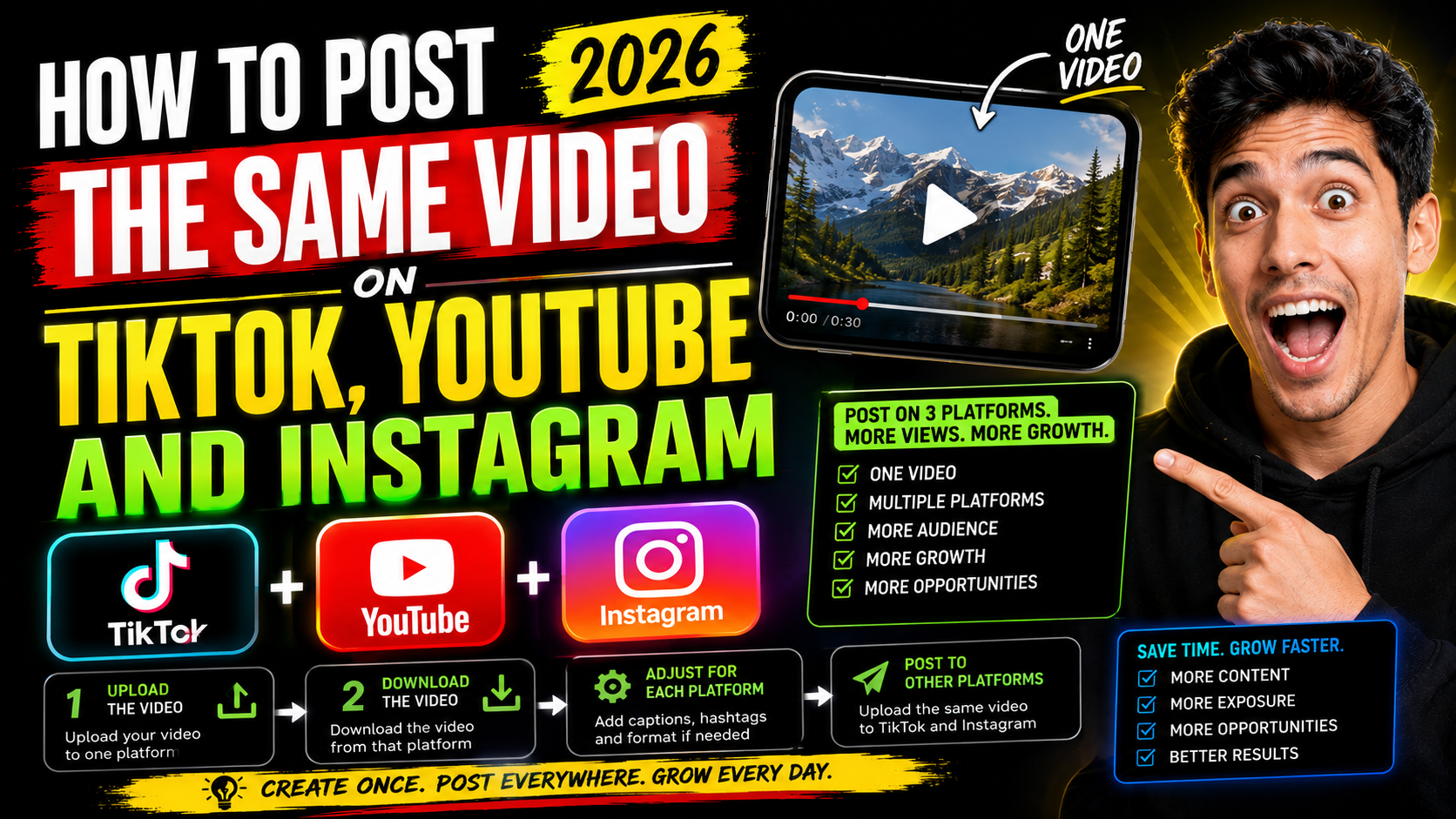
How to Post the Same Video on TikTok, YouTube and Instagram (2026)
One of the smartest growth strategies in 2026 is simple: create a video once, post it everywhere. The same vertical short can perform on TikTok, YouTube Shorts, and Instagram Reels, tripling your reach from a single production. But there is a right way and a wrong way to do it. Done carelessly, cross-posting can trigger watermark penalties and reduced reach. Done correctly, it is the highest-leverage move a faceless creator can make. Here is how to post the same video across all three platforms the right way.
Why cross-posting is so powerful
- 3x the reach from one piece of content.
- Diversification so you are not dependent on one platform's algorithm.
- Faster growth across multiple audiences simultaneously.
- More monetization paths (YouTube ads, TikTok rewards, Instagram bonuses).
The biggest mistake: watermarks
This is the number-one cross-posting error. If you download a video from TikTok (with the TikTok watermark) and upload it to Reels or Shorts, both Instagram and YouTube will suppress its reach. They do not want to promote content advertising a competitor.
Rule: Always post a clean, watermark-free version of your video to each platform. Never recycle a downloaded, watermarked clip.
The solution is to export your original clean file and upload that to each platform, or use a tool that publishes clean versions directly. inVirals exports without watermarks and can post directly to all three platforms, avoiding this problem entirely.
Step 1: Create a platform-agnostic vertical video
Make your video in 9:16 vertical format with captions burned in or added natively. Keep it 15 to 60 seconds. This format works natively on all three platforms. With inVirals, every faceless short is generated in this format by default, ready for universal posting.
Step 2: Export clean (no watermark)
Always keep a clean master file with no platform watermark. This is the version you post everywhere. inVirals exports clean HD by default, so you never risk the watermark penalty.
Step 3: Optimize lightly per platform
While the video stays the same, small per-platform tweaks help:
| Platform | Optimization |
|---|---|
| TikTok | Trendy caption, 3-5 hashtags, post at peak times |
| YouTube Shorts | Keyword-rich title, #Shorts in description |
| Instagram Reels | Engaging caption with a question, 3-5 hashtags |
These take seconds but help each platform's algorithm understand and rank your content.
Step 4: Mind the timing
You can post simultaneously or stagger. Some creators post to TikTok first, then Reels and Shorts a few hours later. Others post everywhere at once. Both work, consistency matters more than exact timing. Post at your audience's peak hours (morning, lunch, evening).
Step 5: Automate the whole thing
Manually uploading the same video to three platforms every day is tedious and error-prone. Automation solves this. Connect your TikTok, YouTube, and Instagram accounts to inVirals, set up a daily series, and the platform generates and posts clean videos to all three automatically. One setup, triple distribution, zero manual uploads.
Step 6: Track per-platform performance
The same video often performs differently across platforms. Check analytics on each and note where your content resonates most. Some niches do better on TikTok; others thrive on Shorts. Use this data to decide where to focus extra effort, while still posting everywhere by default.
Cross-posting checklist
- Video is 9:16 vertical, 15 to 60 seconds.
- Clean export, no watermark from another platform.
- Captions included.
- Platform-specific title/caption and hashtags.
- Posted at peak audience times.
- Performance tracked per platform.
How each platform's algorithm treats reposted content
A myth refuses to die: that platforms punish you for posting a video that also exists elsewhere. That is not how it works. TikTok, YouTube, and Instagram do not scan the open internet to see whether your clip appeared on a competitor. What they actually penalize is a visible competitor watermark and, on Instagram specifically, content the system flags as low-effort recycled material. As long as you upload a clean file natively to each app, all three treat your video as fresh content and rank it on its own merits — watch time, completion, and engagement.
This distinction matters because it frees you to cross-post aggressively without fear, provided you follow the clean-file rule. The reason a downloaded TikTok performs poorly on Reels is not that Instagram "knows" it came from TikTok in some abstract sense — it is that the TikTok logo is literally burned into the pixels, and Instagram's system detects it. Remove that single variable and the playing field levels. This is why exporting from a tool that never stamps a watermark, such as an AI faceless video generator, sidesteps the entire problem at the source.
Native upload versus share links: always go native
Some creators try to save time by posting to one platform and sharing the link elsewhere, or by using a platform's built-in "share to Instagram" button. Avoid this. Every algorithm strongly favors content uploaded natively through its own app or API. A native upload signals that you are creating for that platform, and it unlocks the full set of features — captions, stickers, hashtags, and feed placement — that a shared link does not. The extra two minutes of uploading the clean file directly is repaid many times over in reach.
How captions and text should adapt across platforms
The video itself can be identical, but the surrounding text benefits from light tailoring. Each platform's discovery system leans on different signals. TikTok reads your caption and on-screen text for topic relevance and trend matching. YouTube Shorts behaves more like a search engine, so front-loading a keyword in the title pays off. Instagram weights saves and shares heavily, so a caption that invites the viewer to save or tag a friend nudges the metrics that matter there.
| Element | TikTok | YouTube Shorts | Instagram Reels |
|---|---|---|---|
| Primary text | Short, trend-aware caption | Keyword-rich title | Hook caption + question |
| Hashtags | 3-5 niche + trending | #Shorts + 1-2 topical | 3-5 niche + reach tags |
| Discovery driver | For You algorithm | Search + Shorts feed | Explore + shares/saves |
| Best CTA | "Follow for part 2" | "Subscribe for more" | "Save this / tag someone" |
Sound, music, and licensing across platforms
One genuine cross-posting trap is audio. A trending TikTok sound is licensed for use inside TikTok, but reuploading that same audio to Reels or Shorts can trigger a copyright flag or muted audio. The safe approach for a faceless creator is to use platform-cleared or original music baked into your export, so the same file plays everywhere without rights issues. Tools that generate your video with built-in licensed music solve this automatically, which is one more reason creating a clean master beats recycling a platform-native clip that carries borrowed audio.
A repeatable cross-posting workflow
Here is a workflow you can run every day without thinking about it. First, produce one clean 9:16 video with burned-in captions and licensed or original audio. Second, write three short text variants — one per platform — using the table above. Third, upload natively to all three, or let an automation tool do it. Fourth, log the post in a simple tracker. Fifth, check back in 48 hours and note where it performed best. Repeat. Within a few weeks you will have a clear picture of which platform rewards your niche most, and you can lean into it while still collecting free reach from the other two.
Doing it manually
If you post by hand, batch the work. Generate and export several videos at once, then sit down for a single upload session rather than scattering uploads through the day. Keep your text variants in a spreadsheet so you are copying and pasting rather than writing from scratch each time. Manual cross-posting is viable for one channel, but it becomes a real time sink once you scale.
Doing it automatically
Automation is where cross-posting stops being a chore. Connect your accounts once, set a daily series, and let the system generate clean videos and publish them to all three platforms on schedule. This is the only realistic way to run multiple channels, since the manual approach simply does not scale past one or two. An AI shorts generator with built-in scheduling turns the entire pipeline into a set-and-forget operation, and pairing it with an AI reels generator workflow keeps your Instagram presence native rather than recycled.
Mistakes that quietly kill cross-posting reach
- Reusing watermarked downloads. The single most common error, and the easiest to avoid. Always post a clean master.
- Borrowed trending audio. A sound cleared on one app may be muted or flagged on another. Use original or licensed music in the export.
- Identical generic captions everywhere. Copy-pasting the exact same caption wastes each platform's discovery signals. Tailor the text in seconds.
- Sharing links instead of uploading natively. Native uploads always win on reach. Never rely on cross-share buttons.
- Ignoring per-platform analytics. If you never check where content lands, you cannot double down on the platform that rewards your niche.
- Wrong aspect ratio. A horizontal or square video gets letterboxed and looks amateur in a vertical feed. Always export true 9:16.
Should you tailor the video itself, not just the text?
For most faceless creators, one clean master posted everywhere is the right call — the leverage of "create once, distribute three times" is the whole point. But as you grow, lightly tailoring the video can squeeze out more reach. That might mean a slightly faster cut for TikTok, a keyword spoken in the first line for Shorts, or a more aesthetic opening frame for Reels. These are optimizations, not requirements. Start with the universal version, prove the model, then refine per platform only once a channel earns enough to justify the extra effort.
How staggered posting can squeeze out more reach
While simultaneous posting is the simplest approach, a staggered schedule can occasionally do better. The idea is to let a video prove itself on the fastest-moving platform first, then ride that momentum elsewhere. Many faceless operators post to TikTok in the morning, watch how it performs for a few hours, and then publish the strongest performers to Reels and Shorts later the same day. If a video unexpectedly takes off, you already know it has legs before you spend any effort optimizing captions for the other platforms.
There is a second benefit to staggering. By spacing uploads across the day, you hit multiple peak-traffic windows instead of one. A morning TikTok, a lunchtime Reel, and an evening Short each catch a different slice of your audience when they are most active. The trade-off is that staggering requires either being present through the day or using a scheduler that posts at set times for you. For most people, automation makes this effortless — you queue everything once and the system releases each upload at its optimal hour.
Tracking what works without drowning in data
You do not need a complex analytics setup to cross-post intelligently. Track three numbers per video per platform: views, average watch time or completion rate, and shares or saves. Views tell you reach, watch time tells you whether the content held attention, and shares tell you whether it resonated enough to spread. After 20 or 30 videos you will see clear patterns — maybe your history content quietly dominates on Shorts while your punchier facts win on TikTok. That insight tells you where to invest extra effort and which platform deserves a dedicated content angle. Keep the tracker simple enough that updating it never becomes the reason you skip it.
Scaling cross-posting to multiple channels
Once a single cross-posted channel is humming, the natural next move is to run several. Cross-posting is what makes a multi-channel operation viable, because a single production already yields three platform uploads. Add a second niche and you are publishing six places from two pieces of content. The math is compelling, but it only works if the pipeline is genuinely hands-off — manually uploading to six destinations a day would consume hours and invite mistakes like uploading the wrong file or forgetting a watermark check.
The operators who scale successfully treat their workflow like a system with documented steps: how videos are generated, where clean masters are stored, which text variants go where, and what the posting schedule is. With that playbook written down, adding a channel is mostly a matter of plugging in a new niche and connecting new accounts. Automation tools that generate and publish clean videos across platforms turn this from a logistics nightmare into a few minutes of setup per channel, which is precisely why faceless operators can run portfolios that a solo manual creator never could.
The bottom line
Posting the same video on TikTok, YouTube Shorts, and Instagram Reels is one of the highest-leverage growth tactics in 2026, as long as you avoid watermark penalties and lightly optimize per platform. Better yet, automate it. inVirals generates clean vertical videos and publishes to all three platforms automatically, so you get triple reach from a single production. Start cross-posting on autopilot today.
Frequently asked questions
Can I post the exact same video on all three platforms?
Yes, as long as it is a clean version without another platform's watermark. The same 9:16 vertical video works on TikTok, Shorts, and Reels.
Why do watermarked videos get suppressed?
Platforms reduce the reach of videos that display a competitor's watermark because they do not want to promote rival apps. Always post clean files.
Should I post at the same time on all platforms?
You can post simultaneously or stagger by a few hours. Consistency and peak-time posting matter more than exact synchronization.
Can I automate cross-posting?
Yes. Tools like inVirals connect to all three platforms and post clean videos automatically through a daily series.
Will platforms penalize me for posting the same video everywhere?
No. Platforms do not scan the internet to detect duplicates. They only suppress videos that carry a competitor's visible watermark or recycled low-effort content. A clean native upload is treated as fresh content on every platform.
Can I use the same trending sound on all three platforms?
It is risky. A sound licensed inside one app may be muted or copyright-flagged on another. The safe approach is to bake original or platform-cleared music into your exported file so it plays everywhere without issues.
Should I change the video for each platform or keep it identical?
Start identical to capture the leverage of creating once and distributing three times. Only tailor the video itself — pacing, opening frame, spoken keywords — once a channel grows enough to justify the extra effort.
What aspect ratio works on all three platforms?
Vertical 9:16 is native to TikTok, YouTube Shorts, and Instagram Reels. Exporting in this ratio ensures your video fills the screen on every platform instead of being letterboxed.
How many times a day should I cross-post?
Start with one clean video posted to all three platforms per day. That single production gives you three uploads and is plenty to build momentum. Once your workflow is automated and smooth, you can scale to multiple videos a day or add more channels without proportionally more effort.
Does cross-posting hurt my watch time on any platform?
No. Each platform measures watch time independently on its own native upload. A clean video competes on its own merits everywhere, so posting it in three places simply gives the same content three separate chances to find an audience.