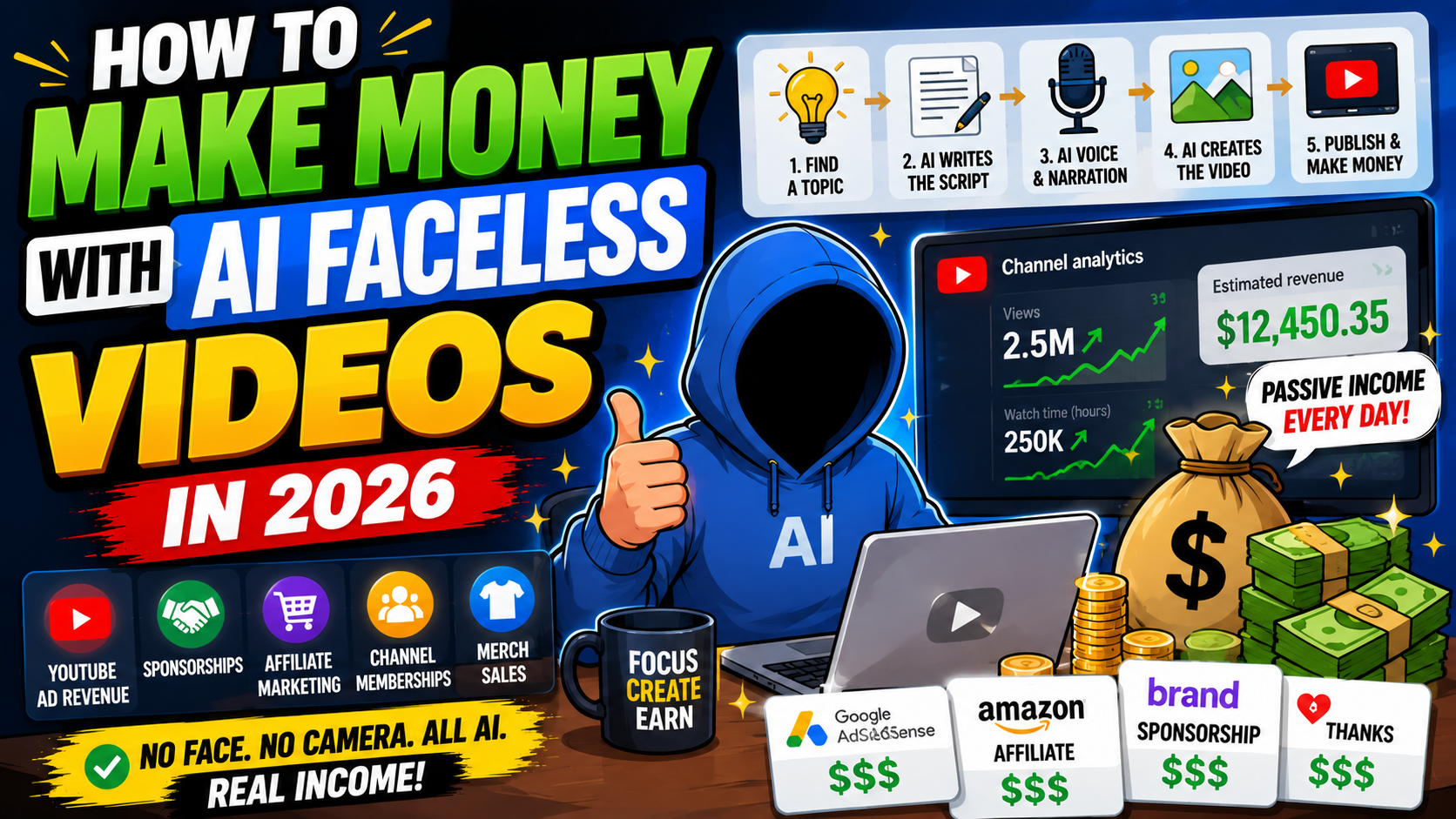
How to Make Money with AI Faceless Videos in 2026
AI faceless videos are no longer a novelty experiment. In 2026 they are a serious revenue channel. Creators run multiple accounts, post daily without ever filming, and stack income from ad revenue, affiliate commissions, brand deals, and digital products. The barrier to entry is lower than it has ever been, and the tools have matured to the point where output quality routinely passes both audience and algorithm standards. A short generated entirely by AI can now hold attention just as well as something filmed on a camera, and viewers increasingly cannot tell the difference.
What separates creators who actually earn from those who quit after two weeks is not talent or luck. It is treating this like a business: choosing a niche deliberately, publishing consistently, and layering multiple income streams instead of betting everything on a single source. This guide covers every proven monetization method, realistic income expectations, the exact production workflow that makes daily posting possible, and the mistakes that quietly kill most channels before they ever earn a dollar.
How the business model works
The formula is simple to describe and harder to execute consistently: AI creates, you publish, platforms and partners pay. Here is the loop that every profitable faceless creator runs in some form:
- Pick a niche with high watch time and strong advertiser demand.
- Use an AI tool like inVirals to generate daily shorts on autopilot.
- Distribute the same content to YouTube Shorts, TikTok, and Instagram Reels.
- Monetize through multiple revenue streams once you cross each platform's thresholds.
- Scale by running multiple channels or expanding into new formats.
The reason this works in 2026 is that production is no longer the bottleneck. Five years ago, making a daily faceless video meant sourcing footage, writing scripts, recording voiceovers, editing, and uploading. Each step took time and skill. Today an AI faceless video generator compresses all of that into a few minutes. The competitive advantage has shifted from "who can produce" to "who can choose the right niche and stay consistent."
Choosing a niche that actually pays
Niche selection is the single most important decision you will make, and most beginners get it wrong by chasing what they personally find interesting rather than what monetizes well. Two factors drive earnings: watch time (how long viewers stay) and RPM (revenue per thousand views, which depends on advertiser demand for your audience).
High-RPM niches
- Personal finance and investing. Advertisers pay heavily to reach people thinking about money. RPMs are among the highest on any platform.
- Business and side hustles. Software, courses, and B2B tools all advertise here.
- Technology and AI. Constant product launches mean constant ad spend and affiliate opportunities.
- Health, wellness, and self-improvement. Supplement and app advertisers are aggressive and audiences are loyal.
High-volume niches
- Motivation and mindset. Lower RPM but enormous reach, and excellent for affiliate book and course sales.
- History, science, and "did you know" facts. Strong completion rates and broadly shareable.
- Scary stories and true crime. Exceptional save and share rates, which feed the algorithm.
- Pop culture and entertainment commentary. Massive volume, though RPM varies.
The smartest play for a beginner is a niche that sits at the intersection: enough volume to grow fast and enough advertiser demand to monetize once you do. A finance channel aimed at beginners, a productivity channel that recommends software, or a health channel built around habits all qualify. Once you pick, commit for at least 60 days before judging results. Jumping between niches resets the algorithm's understanding of your account every time.
Revenue stream 1: Platform ad revenue
Ad revenue is the foundation most creators build on. It is passive once you qualify, and it scales directly with views. Here is how each platform handles it in 2026.
YouTube Shorts
YouTube shares ad revenue with Shorts creators through the YouTube Partner Program. The requirements are 1,000 subscribers plus 10 million Shorts views in the last 90 days (or the long-form alternative of 4,000 watch hours). Earnings vary widely by niche, but Shorts payouts typically range from roughly $50 to $500 per million views depending on your audience's RPM. Finance and business channels sit at the top of that range; entertainment and motivation sit lower but compensate with sheer volume.
TikTok
The TikTok Creator Rewards Program pays based on qualified views, and it favors content longer than one minute. This is worth knowing because it nudges you toward slightly longer faceless formats: a 60 to 90 second story or explainer can earn meaningfully more than a 20 second clip while still performing well. Even shorter clips contribute to your overall standing once you are in the program.
Instagram Reels
Instagram runs bonus and monetization programs for Reels creators that vary by region and are frequently updated. Availability is less predictable than YouTube or TikTok, but the key insight is that cross-posting your existing shorts to Reels costs you nothing extra. It is free additional exposure and a potential revenue stream layered on top of work you have already done.
Key insight: Cross-post the same video to all three platforms. One production, three revenue streams. Tools like inVirals can publish to all three from a single workflow, so this costs no additional production time.
Revenue stream 2: Affiliate marketing
This is where many faceless creators quietly out-earn their ad revenue, often by a wide margin. The concept is simple: you recommend products in your video description or pinned comment, and you earn a commission on every sale that comes through your link. Affiliate income does not require any monetization threshold, which means you can start earning from it on day one, long before YouTube or TikTok will pay you.
- Finance niche: recommend budgeting apps, brokerages, and credit cards. Commissions commonly run $20 to $200 per qualified signup.
- Tech and productivity: software tools and gadgets, typically 5 to 30 percent commission, often recurring for subscriptions.
- Health and fitness: supplements and equipment, usually 10 to 20 percent.
- AI tools: recommend the tools you actually use, including the ones that power your own channel, and earn recurring affiliate income as long as the customer stays subscribed.
The key is matching offers to your niche and your audience's intent. A motivation channel recommends personal development books, journals, and courses. A tech channel recommends software. A finance channel recommends apps. Because the audience already trusts the content, the recommendation converts far better than a cold ad. The mistake to avoid here is promoting irrelevant high-commission products just because they pay well. Audiences sense it instantly, and it erodes the trust that makes affiliate income work.
How to structure an affiliate offer in a faceless video
- Deliver genuine value in the video first. Earn the recommendation.
- Mention the product naturally within the script where it solves the problem you just discussed.
- Place the link in the description and pin a comment with a short call to action.
- Use a clean, branded link so it looks trustworthy rather than spammy.
Revenue stream 3: Brand sponsorships
Once your channel produces consistent views, even 50,000 to 100,000 per month, brands in your niche will start reaching out, and you can also pitch them proactively. Rates for faceless channels typically range from $200 to $2,000 per sponsored mention depending on audience size, niche RPM, and engagement quality. A finance or tech channel with engaged viewers can command rates well above a larger but lower-intent entertainment channel.
The reassuring truth for faceless creators is that sponsors do not care whether you show your face. They care about reach, audience relevance, and trust. A 30-second integrated mention inside a well-performing short delivers exactly what they want. To land deals, keep a simple media kit ready: your monthly views, audience demographics, top-performing content, and example integration formats. Reach out to brands whose products genuinely fit your niche, because relevance is what makes the partnership convert for them and renew for you.
Revenue stream 4: Digital products
Selling your own digital products is the highest-margin revenue stream because you keep nearly everything after platform fees. Once you have built an audience, you can sell your expertise back to it:
- Faceless channel course — teach others how to do what you did. This sells especially well once your own channel shows results.
- Templates and presets — caption styles, script templates, niche research sheets, and hook swipe files.
- Notion and Google Sheets tools — content calendars, niche analyzers, and tracking dashboards.
- Ebooks and guides — deep-dive resources on your niche topic, priced low for volume or high for depth.
Digital products pair naturally with the script and hook work you are already doing. If you use an AI video script generator to plan your content, you can repackage your best-performing scripts and frameworks into a template pack that other creators will pay for. The audience you build becomes both your distribution and your customer base.
Realistic income timeline
| Timeframe | Estimated Monthly Income | Assumption |
|---|---|---|
| Month 1-2 | $0-50 | Building audience, testing content, early affiliate experiments |
| Month 3-4 | $100-500 | Hitting monetization threshold, first consistent affiliate sales |
| Month 5-6 | $500-2,000 | Multiple platforms live, affiliate stacking, first brand inquiries |
| Month 7-12 | $2,000-10,000+ | Scaled channels, recurring brand deals, digital products |
These numbers assume daily posting, a decent niche, and using all available revenue streams rather than just one. Some creators exceed this range significantly; many plateau lower because they quit during the first slow month or never add affiliate and product income on top of ads. Consistency and niche choice are the two biggest variables, and both are entirely within your control.
The workflow: how to produce daily with AI
The reason daily posting is realistic in 2026 is that the production loop is almost entirely automated. With inVirals, the daily workflow looks like this:
- Open the app and enter a topic, or let the AI suggest one based on your niche.
- The AI generates the script, visuals, voiceover, captions, and background music.
- Review the video and optionally adjust captions or timing in the built-in editor.
- Auto-post to YouTube, TikTok, and Instagram on a schedule, or set up a recurring series so it happens without you.
Total active time is roughly 5 to 15 minutes per day, and the rest is automated. If you want to scale even further, an AI shorts generator running on a daily series can publish content while you sleep, which is exactly how creators run multiple channels without working multiple full days.
Common mistakes that kill faceless channels
- Quitting too early. Most channels see little traction in the first month. The ones that win simply keep posting while the algorithm learns what their content is and who to show it to.
- Switching niches constantly. Every pivot resets your account's signals. Pick one and commit for 60 days minimum.
- Relying on a single revenue stream. Ad revenue alone is slow. Layer affiliate income from day one, then add sponsorships and products as you grow.
- Weak hooks. If the first second does not stop the scroll, nothing else matters. Test multiple hook styles and double down on what retains viewers.
- Ignoring analytics. The data tells you exactly which topics and formats to make more of. Creators who optimize weekly grow far faster than those who post and forget.
- Low-effort spam. Mass-producing generic, valueless content gets throttled by platforms. Original, useful videos are what monetize.
Scaling: from one channel to a network
Once one channel is profitable, the playbook simply repeats:
- Launch a second channel in a different niche.
- Use the same AI tool to generate content for both without adding meaningful production time.
- Cross-promote between channels when the audiences overlap.
- Stack affiliate programs across niches so each new channel opens new commission opportunities.
Many full-time faceless creators run three to five channels simultaneously. With AI handling production, the limiting factor is no longer time. It is niche selection and optimization. If you can identify a profitable niche and run a repeatable production system, each additional channel is largely additive income. Check the pricing options to find a plan that supports the output volume your scaling plan requires.
The bottom line
Making money with AI faceless videos in 2026 is straightforward in principle: pick a niche with both volume and advertiser demand, post daily, stack multiple revenue streams, and scale across channels. The tools now exist to make production nearly effortless, which means your real edge comes from consistency, smart niche selection, and treating the whole thing like a business from day one rather than a get-rich-quick experiment.
Start creating AI faceless videos with inVirals and build your first revenue stream today.
Reinvesting early income to grow faster
One habit separates creators who plateau at a few hundred dollars a month from those who build a real business: they reinvest their first earnings instead of spending them. Early income from a faceless channel is not a salary; it is fuel. The most effective place to reinvest is in output volume and testing, because the faster you publish and learn, the faster you find the topics and formats that compound. That can mean upgrading to a plan that supports more videos, launching a second channel in an adjacent niche, or expanding your distribution with an AI Reels generator so the content you already make reaches a third audience.
A practical reinvestment ladder looks like this. Use the first affiliate commissions to cover your tool subscription so the operation pays for itself. Use the next tier of income to increase posting frequency or add a second niche, using the AI video generator to keep production effort flat even as output rises. Once a channel produces reliable monthly revenue, reinvest a portion into your own digital product, which carries the highest margin of any revenue stream and turns your audience into direct customers. The creators who treat early income as fuel rather than reward are the ones who reach the higher end of the income timeline, because every dollar put back into volume and testing buys more of the only two things that actually drive growth: consistency and data.
Frequently asked questions
Is it realistic to make money with AI videos?
Yes. Creators using AI faceless video tools earn through YouTube ad revenue, TikTok creator programs, affiliate commissions, brand deals, and digital products. Income scales with consistency and audience size. The realistic path is steady growth over several months, not overnight riches, but the model genuinely works for people who stay consistent.
How much does it cost to start?
An AI video tool subscription is the main cost. With inVirals you can start creating and publishing without a large upfront investment, and there is no need for a camera, lighting, microphone, or editing software. Compared to traditional content creation, the startup cost is minimal.
How many videos should I post per day?
At least one per day across platforms is the baseline. With AI automation this takes under 15 minutes of active time. More output means faster growth and faster monetization, so creators in growth mode often post two to three times daily once their workflow is dialed in.
Which revenue stream should I focus on first?
Start with affiliate marketing because it has no follower threshold and can earn from your very first videos. Layer in platform ad revenue once you cross the monetization requirements, then add brand sponsorships and digital products as your audience grows.
How long until I see my first real income?
Most consistent creators see their first affiliate sales within the first one to two months and cross platform monetization thresholds around months three to four. The biggest predictor of speed is posting frequency and niche choice, not luck.
Do I need to show my face or use my own voice?
No. The entire model is built around faceless content. The AI generates realistic voiceovers in many languages, so you never need to appear on camera or record audio yourself. This is exactly why the format is so easy to scale across multiple channels.