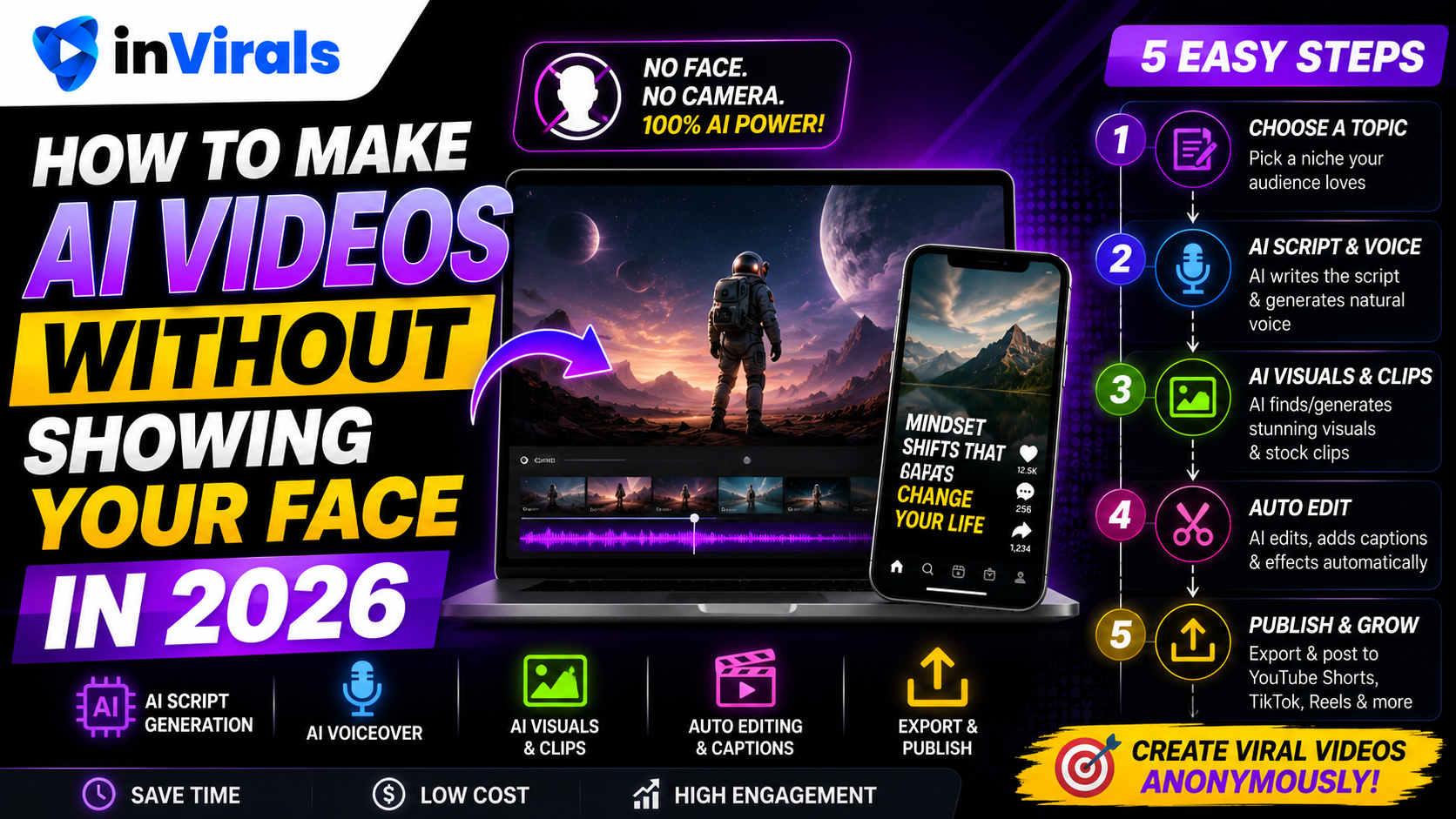
How to Make AI Videos Without Showing Your Face in 2026
Plenty of people want to build an audience and earn online but have no interest in being on camera. Maybe you are camera-shy, value your privacy, or simply do not want your face tied to your content forever. The good news is that in 2026 you do not need to show your face at all. AI tools can generate complete videos, script, visuals, voice, captions, and music, without you ever appearing or even speaking. This guide explains exactly how to make AI videos without showing your face, from concept to monetization.
This is not a compromise format anymore. A few years ago, faceless content meant low-budget slideshows that audiences could spot instantly. Today, some of the largest and fastest-growing accounts across TikTok, YouTube, and Instagram are fully faceless, and viewers often have no idea, because the visuals are original, the narration is natural, and the pacing is native to each platform. The shift happened because the algorithms reward watch time and engagement, not whether a human appears on screen. That neutrality is what makes faceless content viable at the highest level: a well-made faceless short competes on exactly the same terms as a creator's selfie video, and frequently wins because it can be produced at far greater volume.
Why faceless content is a smart choice
- Privacy. Your identity stays separate from your content.
- No performance anxiety. No filming, no awkward takes, no editing yourself. You are never on the hook for a confident delivery, which removes the single most common reason people abandon a channel in the first month.
- Scalability. You can run multiple channels because none depend on you being on camera.
- Sellable assets. Faceless channels can be sold because they are not tied to a personal brand. A channel built on your identity cannot be transferred; a faceless one built on a repeatable system can be handed off or sold as a business.
- Flexibility. Switch niches or styles anytime without rebranding yourself. Since the audience follows the content rather than a person, you can pivot or experiment without the awkwardness of reinventing a personal brand.
The four pillars of a faceless video
Every faceless video is built from four AI-generated components. Understanding them helps you create better content, because a weak link in any one of the four drags down the whole video no matter how strong the others are:
- Script — the words that drive the video, written by AI from your topic.
- Visuals — AI-generated images or video that illustrate the script.
- Voice — a realistic AI voiceover that narrates without you speaking.
- Captions and music — synced subtitles and background audio that boost retention.
A tool like inVirals generates all four from a single topic, so you never have to record anything.
Why people choose to stay off camera
The decision to go faceless is rarely about one thing. For some, it is privacy, they do not want their employer, clients, or extended family stumbling onto their content, and they do not want their face permanently attached to a brand they may pivot away from later. For others, it is confidence, being on camera is genuinely uncomfortable, and no amount of "just be yourself" advice changes that. For many, it is purely practical: filming requires lighting, a decent camera, a quiet space, multiple takes, and editing, and that overhead is exactly what stops them from ever starting. Going faceless removes every one of these barriers at once. You are not hiding a weakness; you are choosing a model that lets you focus entirely on ideas and storytelling rather than on performance and production. The most successful faceless creators treat anonymity not as a limitation but as a strategic advantage that keeps their content scalable and their personal life separate.
Step 1: Choose a faceless-friendly niche
Some niches are naturally suited to faceless content because the story can be carried entirely by narration and visuals, with no presenter required. When choosing, look for a niche that combines broad appeal with an endless supply of topics, so you can produce a new video every day for months without repeating yourself. The best options in 2026:
| Niche | Why it works faceless |
|---|---|
| Motivation | Voiceover over cinematic visuals, no face needed |
| History / documentary | Narration over historical or AI imagery |
| True crime | Storytelling with atmospheric visuals |
| Science / space | Visual-driven, curiosity-based |
| Finance / money | Narration over graphics and b-roll |
| Scary stories | Dark visuals with eerie narration |
| Top lists / facts | Quick narrated rankings with visuals |
Step 2: Generate your script with AI
Enter your topic into the AI script generator. It writes a hook-first script designed for retention, opening line that grabs attention, valuable middle, and a closing loop. You never have to write a word yourself, though you can edit and refine the output until it fits your voice.
Because you are not on camera, your script carries more of the load than it would for a creator who can lean on facial expression and physical presence. Every word has to earn its place. The strongest faceless scripts open with a curiosity gap or a bold claim in the first sentence, deliver the value or story in tight, spoken-style lines, and close on a loop that either circles back to the hook or prompts a follow. Keep sentences short, spoken pacing is faster than written prose, and any filler word is a moment where the viewer might scroll. If you are producing at volume, the script generator can draft many variations quickly, and the hook generator lets you test several different openings on the same body to find the framing that performs.
Step 3: Pick visuals that hide your identity
Because you are not on camera, your visuals do all the showing. inVirals generates original AI imagery in styles like cinematic, anime, documentary, and comic. You can even maintain consistent AI characters across a video for a branded feel, all without a single frame of you.
This is where faceless content has quietly overtaken on-camera content in quality. A few years ago, "faceless" often meant a slideshow of stock photos, visibly cheap and forgettable. Today, original AI visuals generated to match each line of your script look intentional and native, and consistency across videos builds a recognizable identity that viewers follow without ever seeing a person. Lock in one visual style, one caption treatment, and one color palette, then apply them to every video so your content is instantly recognizable in the feed. If your niche is built around explaining ideas, the text-to-video approach turns each script line into a matching visual automatically, so the imagery always supports the narration rather than feeling generic.
Step 4: Add an AI voice (or stay silent)
You do not have to use your own voice. inVirals offers 80+ realistic AI voices in 20+ languages. Choose one that fits your niche and brand. If you prefer, some formats work with text-only and music, no narration at all, but a strong AI voice usually improves retention.
The voice is the closest thing a faceless channel has to a personality, so the choice matters. Match the cadence to the content: brisk and energetic for motivation and facts, slower and more deliberate for suspense and storytelling, calm and clear for educational pieces. A voice that races feels frantic; one that drags loses viewers before the payoff. Generating the same script with two voices and watching both back to back is the fastest way to find the right fit. Multi-language support is also an under-used growth lever, the English feed is crowded, while many other languages have far more audience demand than creator supply, so running the same niche in a second language can open a far less competitive market.
Step 5: Captions, music, and final touches
Add synced captions (essential for mute viewing), background music to set the mood, and subtle effects to maintain attention. inVirals handles captions and music automatically, and the built-in editor lets you fine-tune anything.
For a faceless video, captions do double duty: they make the content accessible on mute and they reinforce the narration for viewers who are half-watching. Use large, high-contrast text in the middle third of the frame with one or two words highlighted as they are spoken. Keep music underneath the voice, around 15 to 20 percent volume, so it adds atmosphere without competing with the narration. Resist the temptation to over-decorate with effects, a clean cut every two to four seconds keeps pacing tight and usually outperforms constant flashy transitions, which distract from the message rather than supporting it.
Step 6: Publish and automate
Connect your TikTok, YouTube, and Instagram accounts and set up a daily series. inVirals generates and posts faceless content automatically, so your channel grows without you appearing, speaking, or even being at your computer.
Automation is what makes faceless content a genuine system rather than another manual chore. Posting once a week, it can take a year to learn what works; posting daily, you gather enough data in a few weeks to identify your winning hooks, niches, and styles, then double down on them. The bottleneck in growth is almost never talent, it is volume and iteration, and a daily series removes the volume problem entirely. Once it is running, your active involvement drops to a few minutes of review and a weekly look at the analytics to decide what to make more of.
Step 7: Monetize your faceless channel
Once you have an audience, faceless channels monetize the same ways any channel does:
- Platform ad revenue (YouTube Partner Program, TikTok Creator Rewards).
- Affiliate marketing — recommend products in descriptions.
- Sponsorships — brands pay for reach, not your face.
- Digital products — sell guides, templates, or courses.
A common worry is that brands will not sponsor a creator they cannot see, but the opposite is often true. Sponsors care about reach and audience fit, not whether a face appears on screen. A faceless channel with 200,000 engaged followers in a defined niche is a more attractive sponsorship target than an on-camera channel with a vague, scattered audience. Faceless channels also tend to have stronger digital-product economics, because the content positions a topic rather than a personality, which makes it natural to sell a guide, template, or course that goes deeper on that topic. The smart sequence is to grow the audience first, layer in affiliate links and ad revenue as soon as you qualify, then introduce your own product once you understand what your audience repeatedly asks for.
Common faceless mistakes to avoid
- Weak hooks. Without a face to hold attention, the first line matters even more. Lead with curiosity or a bold claim, never a slow setup.
- Inconsistent visuals. Switching styles every video stops viewers from recognizing your brand. Lock in one look and keep it.
- Robotic delivery. Choose a voice whose cadence fits the niche and match its pace to the content; the wrong voice quietly tanks retention.
- Posting too rarely. Faceless growth depends on volume. Automate a daily series so consistency does not depend on motivation.
- Quitting a niche too early. Give a niche 30 to 50 videos before judging it. Most channels that fail simply stop before they have enough data.
- Leaking your identity. Reusing a personal username, email, or profile photo undermines the whole point. Keep the channel's identity fully separate.
Running multiple faceless channels
The deepest advantage of faceless content is that it scales beyond a single channel. Because nothing depends on your face or voice, a second channel costs only setup time, not a second identity. Many creators use their first channel as a learning project, then apply what worked, the hooks, the posting times, the visual style, to launch a second one far more efficiently. The sensible approach is sequential: get one channel to consistent traction so you know what success looks like, then clone the system into a new niche using the faceless video generator. Two or three automated faceless channels, each posting daily, is a realistic one-person operation in 2026, and it spreads your growth across niches so a slowdown in one does not stall everything.
Protecting your anonymity
To keep your channel truly faceless and private, treat anonymity as a setup decision you make once rather than something to manage later. A few simple habits keep your real identity fully separated from the channel:
- Use a channel name and branding unrelated to your real identity.
- Use AI voices instead of your own.
- Avoid personal details in scripts.
- Use a separate email for the channel.
The bottom line
Making AI videos without showing your face in 2026 is straightforward and fully achievable. Pick a faceless niche, let AI generate the script, visuals, voice, captions, and music, then publish and automate. You build an audience and income while staying completely behind the scenes, and because the brand is built on a topic rather than your identity, it stays scalable, sellable, and separate from your personal life. Start your faceless channel with inVirals and create your first video without ever turning on a camera.
Frequently asked questions
Can I really build a channel without showing my face or voice?
Yes. With AI scripts, visuals, and voices, you never need to appear on camera or record your own voice. Many successful channels are fully faceless.
Will viewers care that it is faceless?
No. Audiences care about value and entertainment, not whether they see your face. Faceless channels routinely build large, loyal audiences.
How do I stay anonymous?
Use unrelated branding, AI voices, a separate email, and avoid personal details in your content.
What tool makes faceless AI videos easiest?
inVirals generates scripts, visuals, voices, captions, and music from a single topic and auto-posts, making it one of the easiest options in 2026.
Which niches work best for faceless channels?
Motivation, history, true crime, science, finance, scary stories, and fact or list content all work well because narration over visuals carries them without a presenter. The best niche for you combines broad appeal with an endless supply of topics.
Do I need to use my own voice at all?
No. inVirals offers 80+ realistic AI voices in 20+ languages, so you can narrate without ever recording yourself. Some formats even work with text and music only, though a strong AI voice usually improves retention.
Can faceless channels really make money?
Yes. They monetize through ad revenue, affiliate marketing, sponsorships, and digital products, just like any channel. Because the brand is built on a topic rather than a person, sponsorships and product sales often work especially well.
How many videos before a faceless channel gains traction?
Treat your first 30 to 50 videos as data collection. Posting daily, that is roughly one to two months. Most faceless channels that fail simply quit before they have enough videos to learn what resonates.
Can I run more than one faceless channel?
Yes, and many creators do. Since no channel depends on your identity, you can run several in parallel across different niches, each with its own automated daily series.