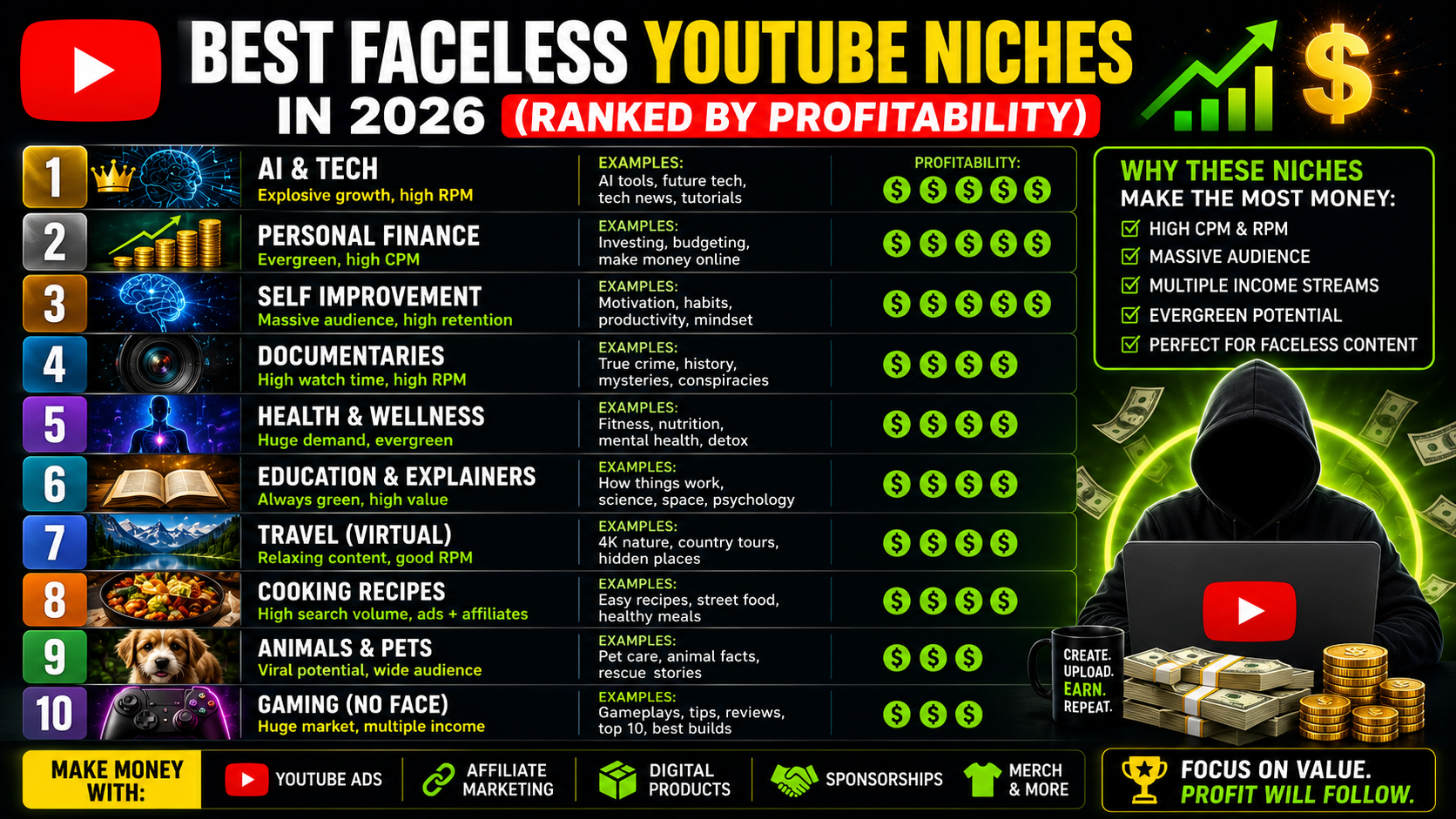
Best Faceless YouTube Niches in 2026 (Ranked by Profitability)
Not all faceless niches are created equal. Some pay premium ad rates but face heavy competition. Others have massive audiences but lower per-view earnings. The smartest move in 2026 is to choose a niche based on a clear understanding of profitability, competition, and how easily it can be automated with AI. This ranked guide breaks down the best faceless YouTube niches so you can pick with confidence and start earning faster.
The three factors that determine niche profitability
- RPM (revenue per mille): How much advertisers pay per 1,000 views. Finance and business top this; entertainment is lower.
- Audience size: How many people the niche can reach. Bigger volume can offset lower RPM.
- Monetization beyond ads: Affiliate, sponsorship, and product potential.
The ranking
Tier 1: Highest profitability
1. Personal finance and investing
The highest-RPM faceless niche. Advertisers pay premium rates, and affiliate opportunities (apps, brokerages, credit cards) are lucrative. Competition is higher, but the earnings ceiling is enormous. Content: budgeting, investing basics, money psychology, side hustles.
2. Business and entrepreneurship
High RPM and a valuable audience. Case studies, lessons, and strategy content. Strong sponsorship and course potential.
3. Technology and AI
Medium-high RPM with surging interest in 2026. Cover AI tools, gadgets, and tech news. Excellent affiliate potential and a fast-growing audience.
Tier 2: Strong balance of reach and revenue
4. Self-improvement and motivation
Massive audience and solid monetization through courses, books, and ads. Lower RPM than finance but huge volume. Easy to automate with cinematic visuals and voiceover.
5. Health and fitness
Broad appeal with strong affiliate options (supplements, equipment, programs). Faceless workout explainers and nutrition content work well.
6. Psychology and human behavior
Highly shareable, evergreen, and pairs well with book affiliates. Strong retention and saves.
Tier 3: High volume, viral potential
7. True crime
Addictive retention and a loyal audience. Lower RPM than finance but excellent watch time and ad volume.
8. Scary stories and horror
Viral on Shorts and TikTok with high share rates. Great for rapid audience growth, monetize through volume and merch.
9. History and documentary
Evergreen with high watch time. Educational and advertiser-friendly. Endless topics.
10. Facts and top lists
Easiest to batch-produce and automate. Huge volume potential, lower RPM, but extremely scalable for daily content.
Profitability comparison
| Niche | RPM | Audience | Competition |
|---|---|---|---|
| Finance | Very High | Large | High |
| Business | High | Medium | Medium |
| Tech/AI | High | Large | Medium |
| Motivation | Medium | Very Large | High |
| Health/Fitness | Medium | Large | Medium |
| True Crime | Medium | Large | Medium |
| Horror | Low-Medium | Large | Low-Medium |
| History | Medium | Medium | Low |
| Facts/Lists | Low | Very Large | High |
Which niche should you choose?
If you want maximum earnings per view and can handle competition, go Tier 1 (finance, business, tech). If you want faster growth and viral potential, Tier 3 (horror, facts, true crime) builds an audience quickly. Tier 2 offers the best balance for most creators. Many successful operators run one high-RPM channel and one high-volume channel to capture both.
Niche profitability myths to ignore
A few stubborn myths steer new creators wrong, and clearing them up saves months of wasted effort.
- "Pick the highest-RPM niche, always." RPM is one factor. A finance channel you abandon from boredom earns nothing, while a motivation channel you post to daily for a year earns real money. Sustainable beats theoretical.
- "Low competition means easy money." Often low competition means low demand. Empty niches are usually empty for a reason. Healthy competition signals a paying audience.
- "Faceless channels can't compete with face channels." In information and entertainment niches, viewers care about the content, not the creator's face. Faceless channels routinely outperform personality-driven ones in finance, history, and facts.
- "You need to be an expert." You need to be accurate and clear, which AI research and careful review provide. Expertise helps you judge quality, but it is not a prerequisite to start.
- "More views always means more money." A million views in a low-RPM niche with no affiliate offer can earn less than a hundred thousand views in finance with strong affiliate conversions. Monetization fit matters more than raw views.
Niche trends shaping 2026
Niches are not static. A few shifts are worth factoring into your choice this year. AI and future-tech content is riding a wave of mainstream curiosity, so the audience is expanding faster than the competition can fill it — a rare window. Personal finance keeps broadening as younger audiences seek money education, deepening an already lucrative niche. Short-form-native education ("explain X in 30 seconds") is exploding as attention spans favor digestible learning. Meanwhile, oversaturated low-effort facts channels are getting harder to grow, which pushes the advantage toward creators who add a distinct angle or higher production quality. None of this means chasing trends blindly; it means picking an evergreen core and being aware of where the tailwinds are blowing.
Matching your personality and goals to a niche
The best niche on paper is the wrong niche if it clashes with how you want to work. If you enjoy research and detail, history or finance will keep you engaged through hundreds of videos. If you prefer fast, punchy output, facts and motivation suit your rhythm. If your end goal is to sell a course or product, choose a niche whose audience buys — finance, fitness, productivity — rather than one that only earns ad pennies. If you want the most hands-off operation possible, the narration-driven niches automate most fully. Spend an honest hour mapping your interests, your strengths, and your monetization goal against the tiers above before committing, because the niche decision is the one choice that is genuinely hard to undo once a channel builds an identity.
| If you want... | Choose | Because |
|---|---|---|
| Highest income per view | Finance, business | Premium advertisers and strong affiliates |
| Fastest growth | Facts, horror, motivation | High volume and viral share rates |
| To sell products/courses | Finance, fitness, productivity | Audience with buying intent |
| Maximum automation | Facts, motivation, stories | Full AI pipeline, light review |
| Long-term evergreen value | History, psychology | Content that ages slowly |
Understanding RPM versus CPM (and why it matters)
Creators throw these terms around interchangeably, but the difference shapes your strategy. CPM is what advertisers pay per 1,000 ad impressions. RPM is what you actually pocket per 1,000 video views after YouTube takes its cut and after accounting for the views that show no ad at all. RPM is always lower than CPM, and it is the number that matters for your income. A finance channel might show a sky-high CPM, but if half its views are on Shorts where monetization is thinner, the blended RPM comes down. When you compare niches, think in RPM, and remember that the same niche earns very different RPMs on long-form versus Shorts.
This is why niche selection and format selection are really one decision. A high-CPM niche like finance reaches its full earning potential in long-form, where mid-roll ads stack up. The same niche on Shorts still beats most others, but the gap between niches narrows because Shorts RPM is compressed across the board. Decide what you want to earn per view, and you have effectively narrowed both your niche and your format at once.
The hidden fourth factor: monetization beyond ads
The three factors above — RPM, audience size, competition — explain ad income, but ad income is rarely where faceless operators make the most money. The real separator is how well a niche supports affiliates, sponsorships, and digital products. A facts channel might pull enormous views at a low RPM and still under-earn a smaller finance channel that converts viewers into brokerage signups. When you rank niches, mentally add a fourth column: "what can I sell here?" A niche with modest views but strong buying intent often beats a viral niche with nothing to offer.
| Niche | Ad income | Affiliate fit | Product/course fit |
|---|---|---|---|
| Finance | High | Excellent | Excellent |
| Business | High | Strong | Excellent |
| Tech/AI | High | Excellent | Good |
| Health/Fitness | Medium | Excellent | Excellent |
| Motivation | Medium | Medium | Strong |
| True Crime | Medium | Weak | Weak |
| Facts/Lists | Low | Weak | Weak |
How competition should shape your choice
High competition is not a reason to avoid a niche — it is proof the niche makes money. Nobody floods into unprofitable spaces. The real question is whether you can carve out a defensible sub-niche. "Finance" is brutally competitive, but "finance for freelancers" or "investing explained for teenagers" is wide open. Sub-niching narrows your audience but sharpens your identity, and a sharp identity is what makes viewers subscribe and the algorithm confident about who to show you to. The most common beginner mistake is going broad in a competitive niche; the fix is to go narrow and own a corner of it.
The sub-niche strategy in practice
Take any Tier 1 niche and slice it by audience, angle, or format. Finance becomes budgeting for new parents. Tech becomes AI tools for small businesses. History becomes military history of a single era. Each slice has less competition, a clearer hook, and an audience that feels the content was made specifically for them. As the channel grows, you can broaden outward from a position of authority rather than starting broad and getting lost in the crowd.
Ease of automation by niche
Some niches are simply easier to run faceless and on autopilot than others. Niches built on narration over visuals — motivation, facts, history, horror — automate beautifully because AI handles the entire pipeline: script, voice, imagery, captions. Niches that depend on live data, fast-breaking news, or precise accuracy require more human review. Finance and tech earn the most but demand that you fact-check every script, since errors damage trust and can mislead viewers. Factor this into your decision: if you want the most hands-off operation, the narration-driven niches are friendliest, while the high-RPM niches trade a bit of extra oversight for higher pay.
| Niche | Automation ease | Review needed |
|---|---|---|
| Facts/Lists | Very easy | Light |
| Motivation | Very easy | Light |
| Horror/Stories | Easy | Light |
| History | Easy | Moderate (accuracy) |
| Tech/AI | Moderate | Moderate (accuracy) |
| Finance | Moderate | Heavy (accuracy) |
The two-channel portfolio strategy
Many of the most successful faceless operators do not pick a single niche — they run a small portfolio. The classic setup pairs one high-RPM channel with one high-volume channel. The high-RPM channel (finance, business, tech) earns strong income per view but grows slowly and needs careful review. The high-volume channel (facts, motivation, horror) grows fast, builds audience momentum, and generates a flood of views that compound over time. Together they balance each other: the volume channel proves your production system and keeps morale up with fast wins, while the RPM channel quietly becomes your biggest earner. Only attempt this once your first channel runs smoothly, since splitting focus too early stalls both.
The reason this is even feasible is that AI removes the production bottleneck. Running two channels manually would mean double the filming and editing — impossible for most people. With an AI faceless video generator handling production and an AI shorts generator feeding daily content, the marginal cost of a second channel is mostly just a second niche decision and a bit more review time.
How to validate and launch your niche
- Confirm you can list 30+ video topics in the niche quickly.
- Open inVirals and generate 5 test videos in different angles.
- Post them and watch retention and engagement over two weeks.
- Double down on the angle that performs best.
- Set up a daily series for automated, consistent output.
Treat the first two weeks as data collection, not a verdict on your worth as a creator. You are testing which angle resonates, not whether the niche works. Once one angle clearly outperforms, pour your energy there and let the AI video generator keep the pipeline full while you focus on optimization.
The bottom line
The best faceless YouTube niche in 2026 depends on your goal: maximum RPM (finance, business, tech), maximum reach (motivation, facts, horror), or balance (health, psychology, true crime). Whatever you choose, AI handles production so you can focus on consistency and optimization. Launch your faceless channel with inVirals in your chosen niche today.
Avoiding the saturation trap
A fear that stops many people from starting is saturation — the sense that every good niche is already crowded. It is half true and entirely solvable. Broad niches are crowded, yes, but saturation lives at the broad level, not the specific one. The "facts" space is saturated; "weird deep-sea biology facts" is not. The "motivation" space is crowded; "discipline for night-shift workers" is wide open. Saturation is simply a signal to go one level deeper, where competition thins and your content can own a clear identity. The creators who complain about saturation are usually the ones trying to compete head-on in the broadest possible category.
There is also a quality dimension. Much of the content flooding popular niches is low-effort and interchangeable, which actually creates an opening: a channel with a sharper hook, a distinct visual style, and consistent posting stands out against a sea of forgettable uploads. AI levels the production field, so your edge comes from a well-chosen sub-niche and disciplined execution rather than from the niche being empty. Pick a specific corner, produce reliably with an AI faceless video generator, and saturation stops being a barrier.
Frequently asked questions
What is the most profitable faceless niche?
Personal finance and investing have the highest RPM, while motivation and facts niches earn through massive volume and affiliates.
Are high-RPM niches too competitive for beginners?
They are more competitive, but with consistent daily AI-produced content and good optimization, beginners can still break in. Sub-niching helps.
Can I switch niches later?
Since faceless channels are not tied to your personal brand, you can pivot or start a new channel anytime.
How do I produce content in these niches?
Tools like inVirals generate scripts, visuals, voices, and captions for any niche and auto-post, making consistent output effortless.
What is the difference between RPM and CPM?
CPM is what advertisers pay per 1,000 impressions; RPM is what you actually earn per 1,000 views after YouTube's cut and unmonetized views. RPM is always lower and is the number that reflects your real income, so compare niches by RPM, not CPM.
Is a competitive niche bad for beginners?
Competition proves a niche is profitable. The key is to sub-niche — instead of "finance," target "budgeting for new parents." A narrower angle has less competition, a sharper identity, and an audience that feels the content was made for them.
Which niche is easiest to fully automate?
Narration-driven niches like facts, motivation, and horror automate most easily because AI handles the entire pipeline with light review. Finance and tech earn more but require careful fact-checking of every script.
Should I focus on one niche or run several?
Start with one and prove your system. Once it runs smoothly, a common strategy is a two-channel portfolio: one high-RPM channel for income and one high-volume channel for fast growth. AI makes running both realistic since it removes the production bottleneck.
Which niche grows fastest in 2026?
Facts, motivation, and horror grow fastest because of high posting volume and strong share rates, while AI and tech content benefits from surging mainstream curiosity. Fast growth usually comes at the cost of lower RPM, so pair a growth niche with strong affiliate or product monetization.
How important is consistency compared to niche choice?
Niche choice sets your ceiling, but consistency determines whether you reach it. A perfectly chosen niche with sporadic posting loses to an average niche with daily, optimized output. AI automation exists precisely to make that consistency achievable without burning out.