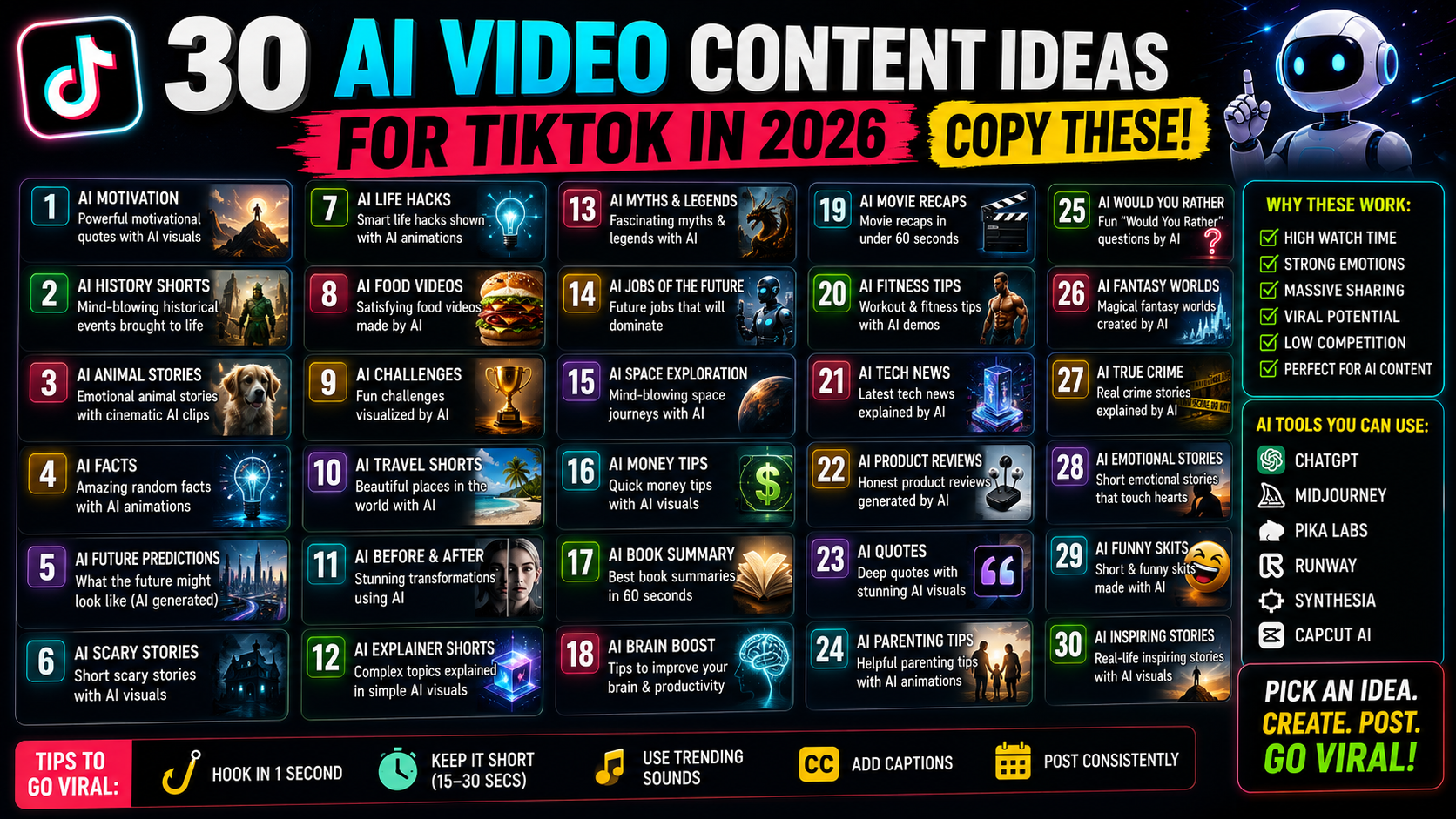
30 AI Video Content Ideas for TikTok in 2026 (Copy These)
Running out of ideas is the silent killer of TikTok channels. You start strong, then hit a wall and posting slows down. The fix is having a deep bank of proven content formats you can pull from anytime. With AI tools, you can turn any of these ideas into a finished video in minutes. Here are 30 AI video content ideas for TikTok in 2026, organized by format, that consistently get views for faceless creators.
Why format matters more than topic
The most reliable way to generate ideas is to think in formats, not random topics. A format is a repeatable structure (like "Top 5..." or "Did you know..."). Once you find a format that works in your niche, you can produce endless variations. AI makes this especially powerful because you can batch-generate dozens of videos in the same proven format.
Story and narrative formats
- "The untold story of..." — a surprising history or backstory in your niche.
- POV scenarios — "POV: you discover..." with atmospheric visuals.
- Reddit-style stories — dramatic personal stories narrated over visuals.
- "What really happened to..." — mystery or unresolved events.
- Two-part cliffhangers — end part one on a hook to drive part two views.
Educational and fact formats
- "Did you know..." — one surprising fact per video.
- "3 things you didn't know about..." — quick listicle.
- Myth-busting — "You've been told X, but actually..."
- "How [thing] actually works" — simple explainer.
- Historical comparisons — "Then vs now" in your niche.
Ranking and list formats
- "Top 5..." — rankings in your niche.
- "Ranked from worst to best..." — builds anticipation.
- "The most [superlative]..." — most dangerous, expensive, mysterious.
- "Tier list" — categorize items in your niche.
- "5 [things] that will [outcome]" — benefit-driven list.
Motivational and advice formats
- "Stop doing this..." — common mistake plus the fix.
- "Do this for 30 days..." — challenge-based.
- "The harsh truth about..." — bold, contrarian advice.
- "What I wish I knew at 20..." — life lessons.
- Quote breakdowns — explain a powerful quote with visuals.
Curiosity and engagement formats
- "This will blow your mind..." — a genuinely surprising reveal.
- "Can you guess..." — interactive question that drives comments.
- "The reason behind..." — explain something people wonder about.
- "What happens if..." — hypothetical scenarios.
- "You won't believe..." — astonishing facts or events.
Trending and timely formats
- News explainers — break down a trending topic in your niche.
- "X explained in 30 seconds" — fast, digestible breakdowns.
- Predictions — "What [niche] will look like in 2030."
- Comparisons — "X vs Y: which is better?"
- Reaction-style — commentary on a surprising fact or event.
How to turn these ideas into videos fast
Pick a format, then use inVirals to produce it:
- Enter the format and topic (e.g., "Top 5 most mysterious places on Earth").
- Let the AI write a hook-first script.
- Choose a matching visual style and voice.
- Generate, review, and post, or add to a daily series.
Pro tip: When a format performs well, batch-generate 5 to 10 more videos in that same format. Doubling down on winners is how channels scale.
Matching ideas to your niche
These 30 formats are universal skeletons — the magic happens when you wrap them around your specific niche. The same "did-you-know" format produces wildly different videos depending on whether your channel is about space, money, history, or psychology. Think of the format as the container and your niche as the contents. Below is how a few formats translate across popular faceless niches, so you can see the pattern and apply it to yours.
| Format | Finance niche | History niche | Psychology niche |
|---|---|---|---|
| Did-you-know | "Did you know banks profit from your idle cash?" | "Did you know Rome had skyscrapers?" | "Did you know your brain decides before you do?" |
| Top 5 | "5 money habits of the wealthy" | "5 empires that vanished overnight" | "5 biases that control you" |
| Stop doing this | "Stop keeping savings here" | "Stop believing this myth about the pyramids" | "Stop apologizing for this" |
| The untold story | "The untold story of the 2008 crash" | "The untold story of a forgotten queen" | "The untold story of why we dream" |
Once you internalize this, idea generation becomes effortless: grab a format, point it at your niche, and you have a video. A purpose-built AI TikTok video generator speeds this up further by writing the script and assembling the visuals from a single prompt.
Reading TikTok trends without chasing them
There is a difference between riding a trend and chasing one. Chasing means jumping on a sound or meme that has nothing to do with your niche, gaining a burst of irrelevant views, then watching them evaporate because the audience does not care about your actual content. Riding means adapting a trending format or angle to your niche so the new viewers it attracts are the right ones. The formats above are evergreen, but you can layer a current trend on top — for example, framing a "did-you-know" fact around a topic that is having a cultural moment.
The smart play is to keep your evergreen format library as the backbone — that is what you post daily — and treat trends as occasional boosters, not your whole strategy. Channels built entirely on trends collapse the moment the trend fades, while channels built on evergreen formats compound steadily and use trends to spike reach now and then. When a trend does fit your niche, move fast, because TikTok trends have short half-lives, and AI generation lets you produce a relevant video in minutes rather than days.
Posting cadence and timing on TikTok
Ideas are only half the equation; how often and when you post determines how much reach they get. TikTok rewards consistency, and the platform's discovery engine gives even small accounts a real shot at the For You page with every upload. A realistic, sustainable cadence for a faceless creator is one to three videos a day. More than that risks quality dropping; fewer slows the algorithm's ability to learn what your account is about. The key is steadiness — three videos a day for thirty days beats twenty videos in one burst followed by silence.
For timing, aim for your audience's active windows: early morning, lunchtime, and evening tend to perform best for most niches, though your own analytics will reveal the real peaks once you have a few weeks of data. Do not obsess over the perfect minute. Consistency and volume matter far more than hitting an exact posting time, and batch-generating content in advance with an AI shorts generator means you always have videos ready to go at the right hours.
Why some ideas flop (and how to fix them)
Even great formats sometimes underperform, and the reason is almost always one of a handful of fixable issues. Diagnosing flops is how you improve faster than creators who just keep guessing.
- Weak first second. If your average watch time collapses immediately, the hook failed. Regenerate the opening line with a stronger curiosity gap or bolder claim.
- Too much information. Cramming three ideas into one video splits attention. One idea per video, always.
- Slow pacing. Dead air and long pauses lose viewers. Tighten the script and cut filler so every second earns its place.
- No payoff. If you tease something in the hook, you must deliver it. Broken promises tank completion and trust.
- Wrong format for the niche. A slow narrative format may flop in a niche that wants fast facts. Test which formats your specific audience rewards.
- Forgettable ending. Trailing off kills shares and loops. End on impact, a question, or a loop back to the opening.
When a video flops, do not delete it in a panic — read the retention graph and identify exactly where viewers dropped. That single data point tells you what to fix next time, and over dozens of videos these lessons compound into a real edge.
Visual styles that make these ideas pop
A great idea with flat visuals still flops on TikTok, because the feed is a visual medium first. Each format above has a visual style that amplifies it, and choosing the right one is as important as the script. Story and POV formats thrive on atmospheric, cinematic imagery that pulls viewers into a world. Fact and educational formats benefit from clean visuals with bold, readable on-screen text so the key point lands even with the sound off. Ranking and list formats work best with punchy cuts and a number or progress indicator that builds anticipation toward the top spot. Motivational formats demand sweeping, dramatic visuals paired with a resonant voice.
| Format group | Visual style | Voice tone | Captions |
|---|---|---|---|
| Story / POV | Cinematic, atmospheric | Slow, immersive | Minimal, mood-setting |
| Facts / educational | Clean with bold text | Clear, confident | Large, high-contrast |
| Rankings / lists | Fast cuts, counters | Energetic | Numbered, animated |
| Motivation | Dramatic, sweeping | Deep, powerful | Punchy keywords |
When you generate a video, set the visual style deliberately to match the format rather than accepting whatever default appears. This single habit separates videos that stop the scroll from videos that blend into the feed. The right pairing of idea, visuals, voice, and captions is what makes a format reach its full potential.
Building a 30-day content calendar from these ideas
Thirty ideas conveniently map to a full month of posting, but a smarter approach is to rotate proven formats rather than burn through all thirty once. Assign formats to days of the week so your audience learns your rhythm. For example: Monday rankings, Tuesday did-you-know, Wednesday a story, Thursday a "stop doing this," Friday a comparison, and the weekend reserved for whatever has been performing best lately. With seven format slots and an endless supply of topics in your niche, the same structure runs indefinitely without feeling repetitive.
The benefit of a fixed calendar is twofold. First, it removes daily decision fatigue — you already know what type of video Tuesday needs, so you only choose the topic. Second, predictable formats build viewing habits; when followers know you post a fascinating fact every Tuesday, they return for it. Batch your production once a week: sit down, generate seven to ten videos across your format slots, queue them, and let an automated series publish them at peak times. This turns a daunting daily task into a single weekly session.
Engagement formats that drive comments and shares
Views are good, but comments and shares are what tell TikTok your video deserves a wider audience. Certain formats are engineered to provoke interaction. Questions ("Can you guess what happens next?") invite comments. Controversial-but-defensible takes ("This common advice is actually wrong") spark debate. Relatable callouts ("If you do this, we can't be friends") get tagged and shared. Incomplete loops ("Part 2 tomorrow") drive follows. When you build a video around an engagement trigger, you are not just entertaining — you are recruiting the algorithm's help.
- Ask a question the audience genuinely wants to answer in the comments.
- Take a stance that invites friendly disagreement without being offensive.
- Create a relatable moment people tag their friends in.
- Tease a follow-up so viewers follow to catch part two.
- Prompt a save by packing the video with genuinely useful information.
Sprinkle these triggers across your calendar so a portion of your videos are explicitly built to spark interaction. The comments they generate often push a modest video into a much larger audience than its raw view count would suggest.
Turning one idea into a whole content cluster
One of the most underused tactics is multiplying a single winning idea into a cluster of related videos. When a video performs well, it has told you something valuable: this topic and angle resonate with your audience. Instead of moving on, mine it. A successful "5 money mistakes" video can spawn a deeper dive on mistake number one, a "5 more money mistakes" sequel, a "the worst money mistake I ever saw" story, and a "how to fix mistake number three" tutorial. Five videos, one validated idea, each riding the proven appeal of the original.
This approach compounds because the algorithm already knows the original performed, and viewers who liked it are primed for more on the same theme. It also slashes ideation time — instead of hunting for fresh concepts daily, you expand winners. With AI generation, producing a cluster of five related videos takes a single sitting, and you can have an entire week of content built around one proven topic before lunch.
The content idea mindset that never runs dry
The creators who never run out of ideas are not more imaginative than everyone else — they have simply trained themselves to see the world through formats. Once you internalize the thirty formats above, every article you read, every conversation you have, and every fact you stumble across becomes a potential video. A surprising statistic is a "did-you-know." A common error is a "stop doing this." A historical event is a story. This reframing turns the entire world into raw material, and it is why a systematic creator with a format library will always outlast someone waiting for inspiration to strike.
The content idea system
Never run out again by building a simple system:
- Keep a spreadsheet of formats that work in your niche.
- Each week, pick 2 to 3 formats and generate 7 to 10 videos.
- Track which formats and topics get the best retention.
- Refresh your list with new formats monthly.
The bottom line
The secret to never running out of TikTok content is thinking in formats and batch-producing with AI. Use these 30 ideas as your starting bank, find the formats that resonate in your niche, and scale your winners. Start generating TikTok videos with inVirals and turn any of these ideas into a finished video in minutes.
Frequently asked questions
How do I come up with TikTok content ideas?
Think in repeatable formats (lists, facts, stories) rather than random topics. Find formats that work in your niche and produce endless variations.
How many videos should I make from one idea?
When a format performs, batch-generate 5 to 10 variations. Doubling down on what works is the fastest way to grow.
Can AI generate these video ideas for me?
Yes. Tools like inVirals can suggest trending topics and write hook-first scripts for any format you choose.
Which format works best on TikTok?
It varies by niche, but story/POV, did-you-know facts, and ranking lists consistently perform well across most niches.
How many videos should I post on TikTok per day?
One to three per day is a sustainable, effective cadence for faceless creators. Consistency over weeks matters more than volume in a single burst, and AI generation makes a steady daily output realistic without burning out.
Should I jump on every TikTok trend?
No. Chasing unrelated trends brings irrelevant views that do not convert to followers. Instead, keep an evergreen format library as your backbone and layer a trend on top only when it genuinely fits your niche.
Why did my video flop even though the idea was good?
The most common causes are a weak first second, too much information, slow pacing, or a missing payoff. Read the retention graph to see exactly where viewers dropped off, then fix that specific issue on your next video.
How do I match visuals and voice to a format?
Pair the tone of the format with the delivery. Mysterious and story formats want darker visuals and a slower, deeper voice; energetic motivation and facts formats want dynamic imagery and an upbeat voice. The format and delivery should reinforce the same emotion.